Teardown · public data, not a client
QUITTR
Become your best self again
QUITTR is a porn-recovery app launched in 2024 by two founders in their early twenties that its co-founder says earns over $500,000 a month. Because App Store search returns nothing for “quit porn”, it grows through creators and its own brand name, then converts with a 10-question quiz and a paywall with no free trial.
QUITTR's founders met through Y Combinator's co-founder matching, sat down at a San Francisco Chipotle in July 2024, and launched an app Alex Slater had built in ten days. By March 2026 he was telling New York magazine it earned more than $500,000 a month. We installed it on October 6, 2026, recorded every screen from first launch to the paywall, and checked how it can be found in App Store search. The short answer to the second question explains most of the first.
Subject · US App Store · Health & Fitness
App Store ID 6532588521
Open listing →
Title
QUITTR - Break Free Now
Subtitle
Become your best self again
Developer
Quittr, LLC
Rating
4.72 ★ · 33,689
Released
2024-07-23
Version
219 · 2026-06-23
Min iOS
17.0
Size
190.2 MB
Languages
English, Spanish
Bundle
com.vnm.i-give-up
Specimen pulled 2026-10-07
Public signals
Ratings · US App Store
iTunes Lookup API · high conf.
33,689
4.72 average
Monthly revenue
New York magazine · low conf.
$500K+
co-founder's claim, Mar 2026
Downloads
New York magazine · low conf.
1.5M
co-founder's claim; listing says 2M+ users
Monthly active users
Sensor Tower via New York magazine · medium conf.
≈1M
third-party estimate
“quittr” search popularity
Astro, US, Oct 6 2026 · high conf.
60
ranks #1
Localizations
App Store listing · high conf.
2
English, Spanish
Methodology · figures pulled from Apple's public iTunes Lookup API and the live App Store listing on 2026-10-07. Refreshed every quarter. Last verified 2026-10-07. Confidence ratings reflect cross-source agreement; numbers tagged “medium” or “low” should be cited with the original source, not ASOitis.
01 · ASO breakdown
What we'd underline.
F — 01
The category can't be searched.
In our October 6, 2026 check through Astro, App Store search returned no apps at all for “quit porn”, “porn blocker”, “porn addiction” or “stop porn”. Whatever the reason, the effect is the same: the most literal description of QUITTR's category leads nowhere. An app in this space can't rank for what it does.
“The most literal description of QUITTR's category leads nowhere.”
F — 02
So the brand had to become the search.
“quittr” scores a popularity of 60 in Astro's US data, and QUITTR ranks #1 for it. That's demand created outside the App Store — by creators the founders pay per thousand views, according to co-founder Connor McLaren. In a category the store won't index, the name is the only keyword you can own.
Lesson · 02
F — 03
It wins the euphemisms.
QUITTR ranks #1 for “nofap” (popularity 26), #2 for “self control” (17) and #2 for “quit” (8). These are the words people use when the literal ones don't work, and QUITTR holds the top of each.
Lesson · 03
F — 04
One open door: “dopamine detox”.
“dopamine detox” scores popularity 20 with difficulty 17 — the easiest keyword in our probe — and the app ranking first has 23 ratings. QUITTR, which talks about dopamine on its education screens, isn't in the top 50. Its title and subtitle (“Break Free Now”, “Become your best self again”) contain no searchable category phrase at all.
Lesson · 04
F — 05
Two languages for a global audience.
The listing ships in English and Spanish only. Co-founder Connor McLaren told The Week in 2025 that the app had downloads from more than 120 countries; every other language is reach left on the table, especially in markets where English-language creators don't travel.
Lesson · 05
F — 06
The listing leads with a number it doesn't use consistently.
The description opens “Join over 2,000,000 users!” and calls QUITTR “the #1 recovery app”. Inside the app, one screen says “With over 2,000,000 users” and another says “1,000,000+ people chose freedom with QUITTR”. In March 2026, Slater told New York magazine 1.5 million downloads.
Lesson · 06
02 · App Store search probe
Where it ranks today.
We tracked 14 keywords for QUITTR in the US App Store through Astro on October 6, 2026. Popularity and difficulty are Astro's 0–100 scores; rank is QUITTR's position in live results. The striking rows are the porn-related searches: App Store search returned no apps for them at all, so the minimum popularity score of 5 reflects an empty result, not a quiet niche.
| Keyword | Popularity | Difficulty | QUITTR rank | Ranks #1 |
|---|---|---|---|---|
| habit tracker | 67 | 70 | Not in top 50 | Habit Tracker |
| quittr | 60 | 56 | 1 | QUITTR |
| nofap | 26 | 39 | 1 | QUITTR |
| dopamine detox | 20 | 17 | Not in top 50 | Rewire: Dopamine Detox |
| self control | 17 | 44 | 2 | Opal: Screen Time Control |
| quit | 8 | 62 | 2 | Days Since: Quit Habit Tracker |
| addiction recovery | 5 | 55 | 4 | I Am Sober |
| quit porn | 5 | 63 | No results | No apps returned |
| porn blocker | 5 | 59 | No results | No apps returned |
| porn addiction | 5 | 65 | No results | No apps returned |
| stop porn | 5 | 62 | No results | No apps returned |
03 · Trajectory
The public timeline.
2024-07
Alex Slater and Connor McLaren, matched through Y Combinator's co-founder platform, meet in San Francisco. Slater has just built the app in ten days.
2026-03-05
New York magazine profile: Slater says 1.5 million downloads and more than $500,000 a month; Sensor Tower estimates nearly 1 million monthly active users.
2026-03-10
404 Media reports the exposure covered intimate data of hundreds of thousands of users, many of them minors.
2026-03-31
Slater tells Dazed the team “identified and addressed a potential issue, engaged a security review, and implemented additional safeguards”.
2026-04-06
404 Media reports that at least three people had warned QUITTR about the security issue for months.
2026-06-23
Version 219 ships. As of October 7, 2026 the listing shows 33,689 ratings at 4.72 stars.
04 · Monetization
The money path.
QUITTR runs a hard paywall with no free trial. Our recording offered two plans — annual, pre-selected, and lifetime — after a long sales sequence: a personal quit date, a scrolling page of benefits and testimonials, a “Special Discount” card, a product tour and a day-by-day plan. McLaren's explanation of the model, as reported by New York magazine: when the app was free, “people weren't using it”, because “when something's free, there's no value in it”.
IAP ladder
Annual
Pre-selected. Shown with a struck-through “$14.99” reference price — in dollars, beside a rupee price.
₹2,999 / yr
Lifetime
Shown with a struck-through “$449.99”. At under twice the annual price, it's the better deal for anyone planning to stay longer than about 20 months.
₹4,999 once
App Store list
The US product page lists monthly, yearly and lifetime purchases at several price points each, consistent with price testing.
$9.99–$49.99
Paywall triggers
- →Shown after a quiz result, a symptoms checklist, 11 education and benefit slides, testimonials, a goals screen and a personalised quit date (“Jan 4, 2027” for our tester).
- →The sales page repeats one button — “Become a QUITTR” — over “Purchase appears Discretely · Cancel Anytime”, addressing privacy before price.
- →The final plan sheet adds urgency: “60% Off Sale · 9 spots remaining”.
Leaky moments
- ✕Two different discounts in one flow: “Get 80% off on QUITTR Premium!” on the sales page and “60% Off Sale” on the plan sheet.
- ✕Dollar reference prices struck through beside rupee prices — on a non-US storefront, the “sale” compares different currencies.
- ✕No trial means the first charge is the first real use of the app.
05 · Paywall teardown
What the paywall does.
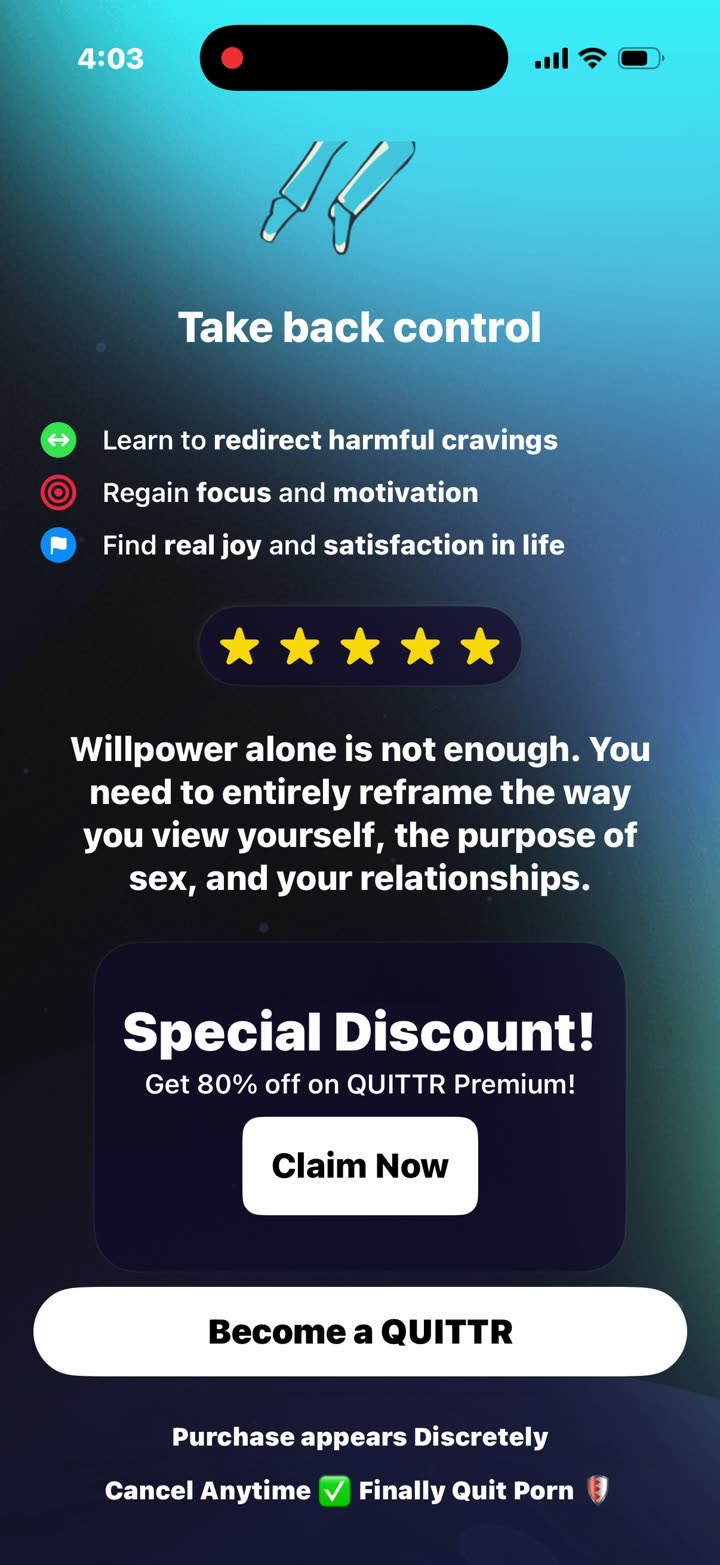
The sales page: benefits, a five-star testimonial and “Special Discount! Get 80% off on QUITTR Premium!”, with “Become a QUITTR” pinned at the bottom.
- ·“Purchase appears Discretely” answers the privacy worry first.
- ·The 80% figure doesn't match the 60% shown on the plan sheet.
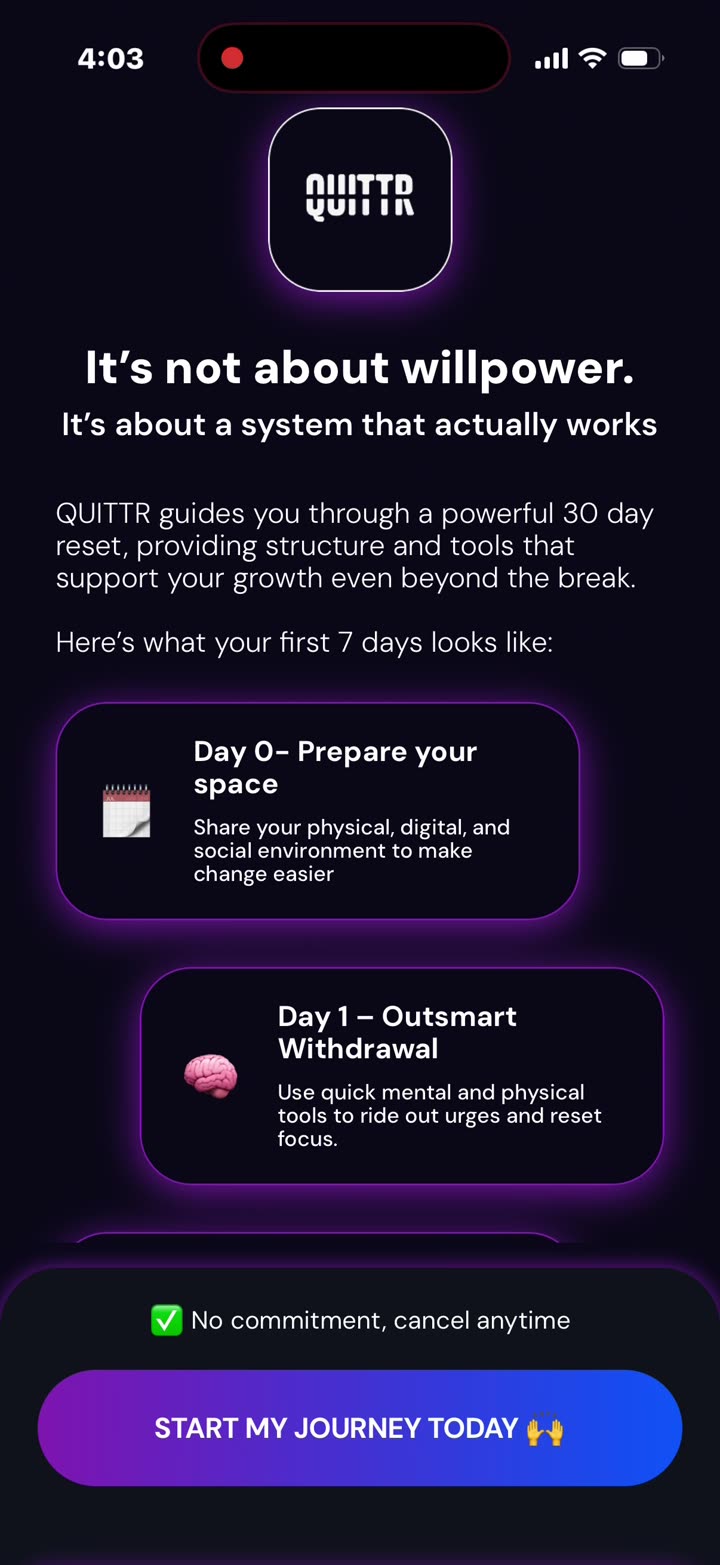
“It's not about willpower. It's about a system that actually works.” A 30-day reset, previewed as a first-week plan from Day 0 to Day 7.
- ·Sells a programme, not features.
- ·“No commitment, cancel anytime” sits above the button.
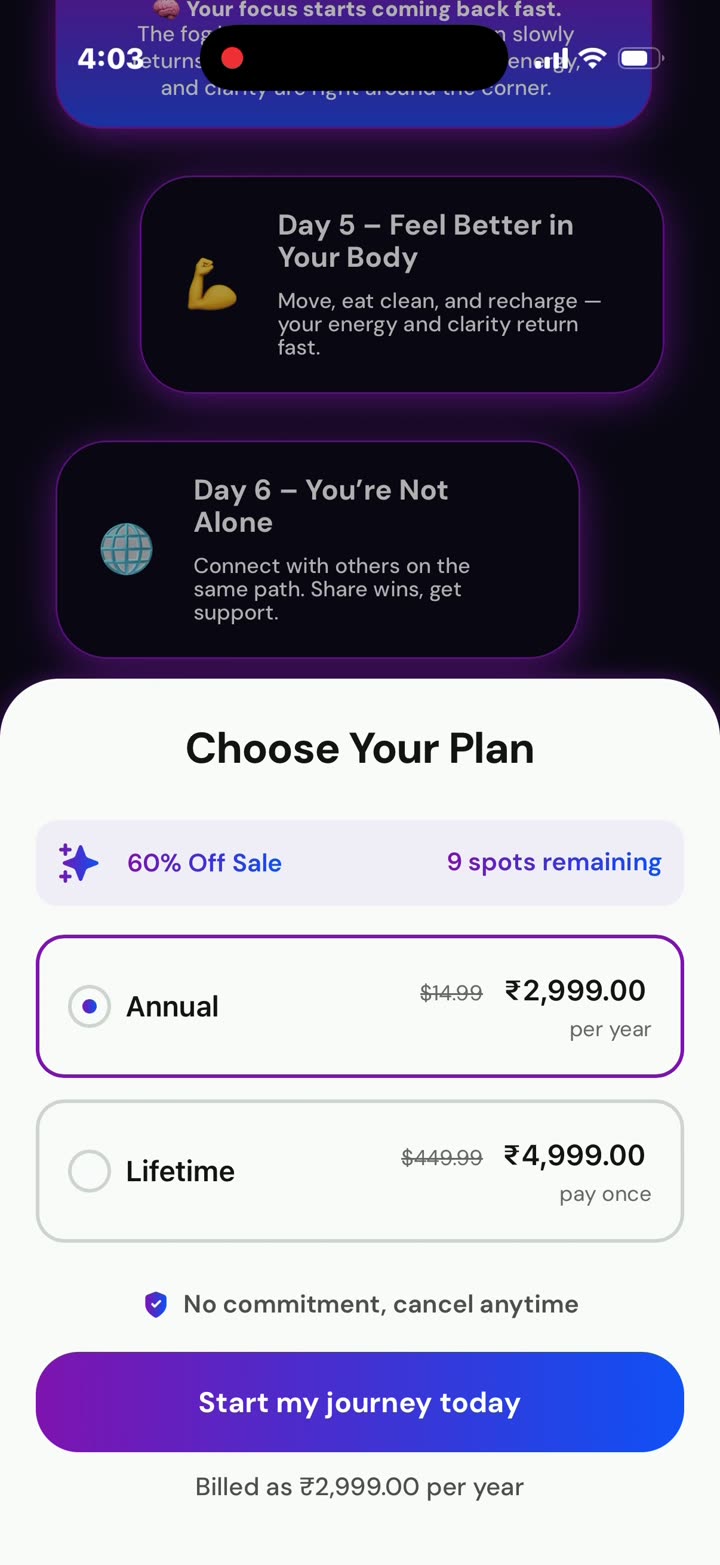
Plan sheet: “60% Off Sale · 9 spots remaining”. Annual ₹2,999 per year is pre-selected; lifetime is ₹4,999. Struck-through prices are in dollars.
- ·Scarcity copy (“9 spots remaining”) on a digital product.
- ·No trial and no monthly plan.
- ·“Billed as ₹2,999.00 per year” states the charge under the button.
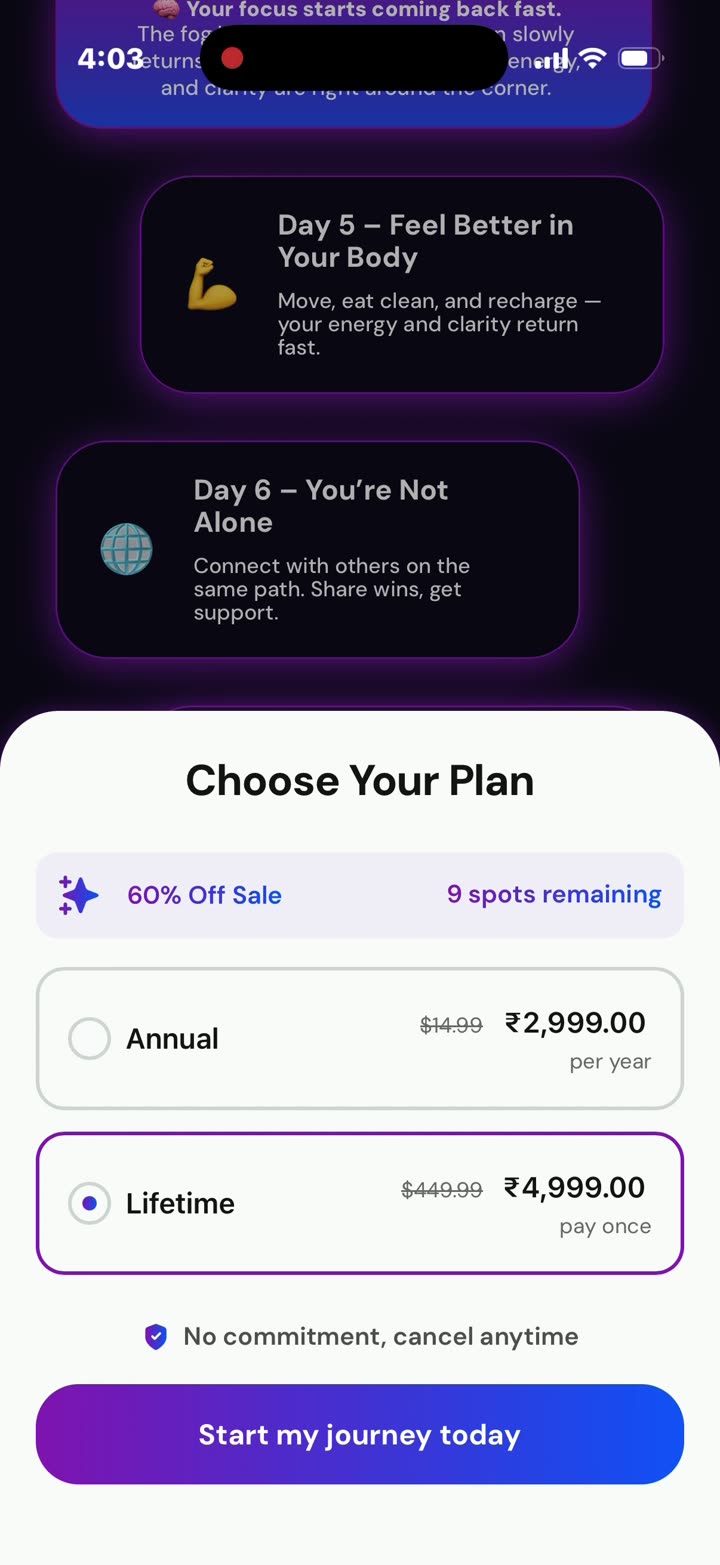
With lifetime selected. At less than twice the annual price, it's priced to be chosen by committed users.
06 · Onboarding teardown
Screen by screen.
QUITTR's onboarding runs about two minutes and fifty seconds for our tester and more than 35 screens before the paywall. It's built as an assessment, not a setup wizard: a numbered 10-question quiz with a “Skip test” link on every screen, a result, a symptoms checklist, then education, authority and social proof — and two system prompts plus Apple's rating request along the way.
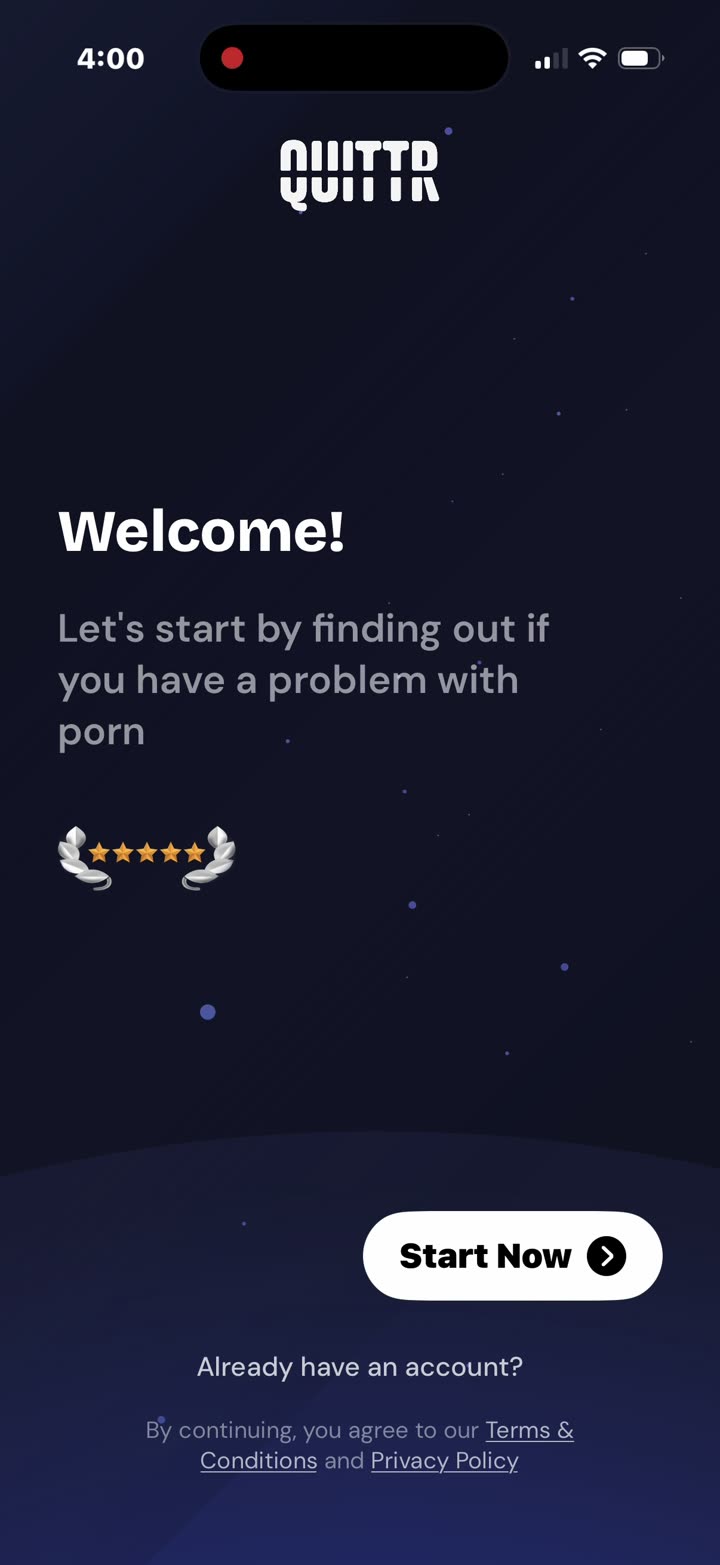
“Welcome! Let's start by finding out if you have a problem with porn.” Start Now.
Frames the whole flow as a diagnosis from the first screen.
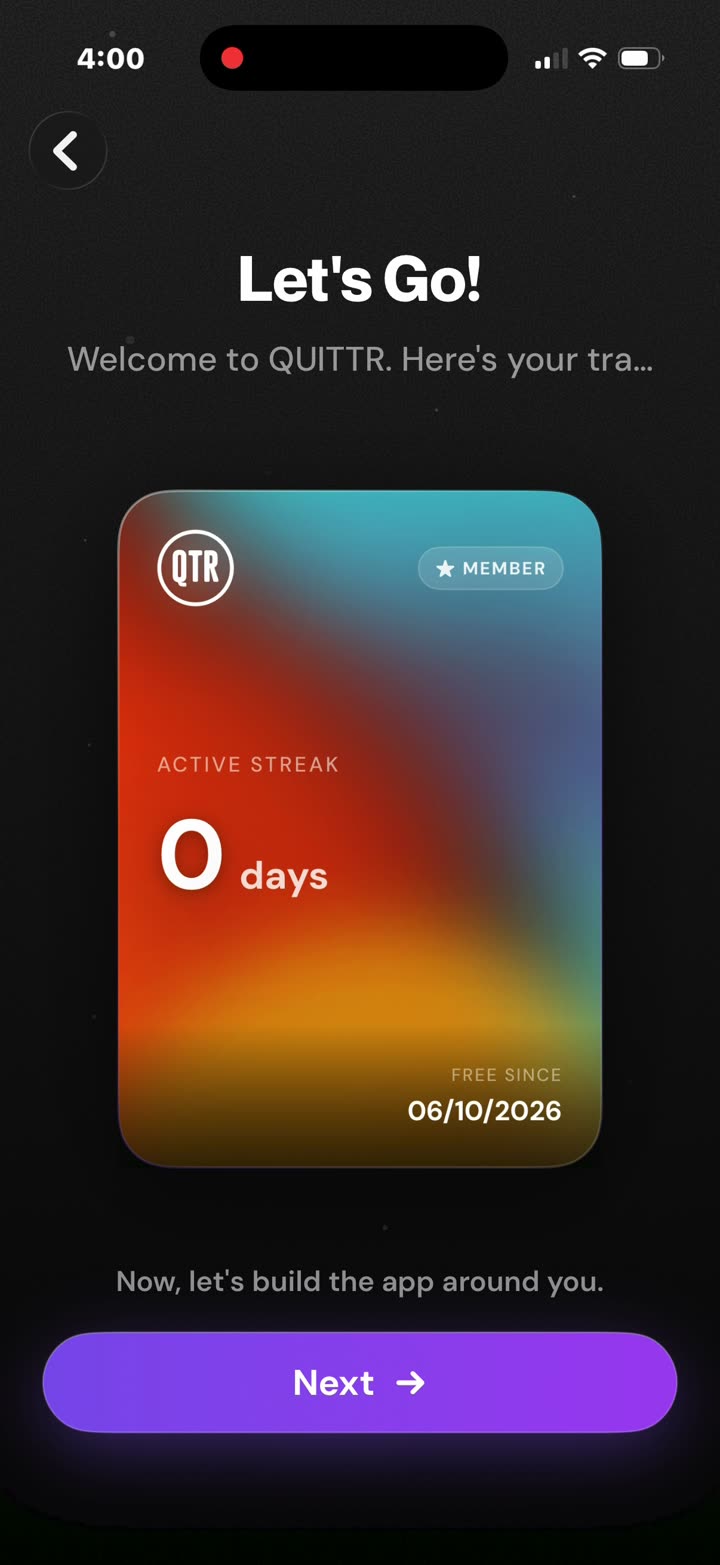
“Let's Go!”: a membership card with “Active streak 0 days” and today's date, before a single question.
The user holds a product artefact — a card with their start date — before giving any information.
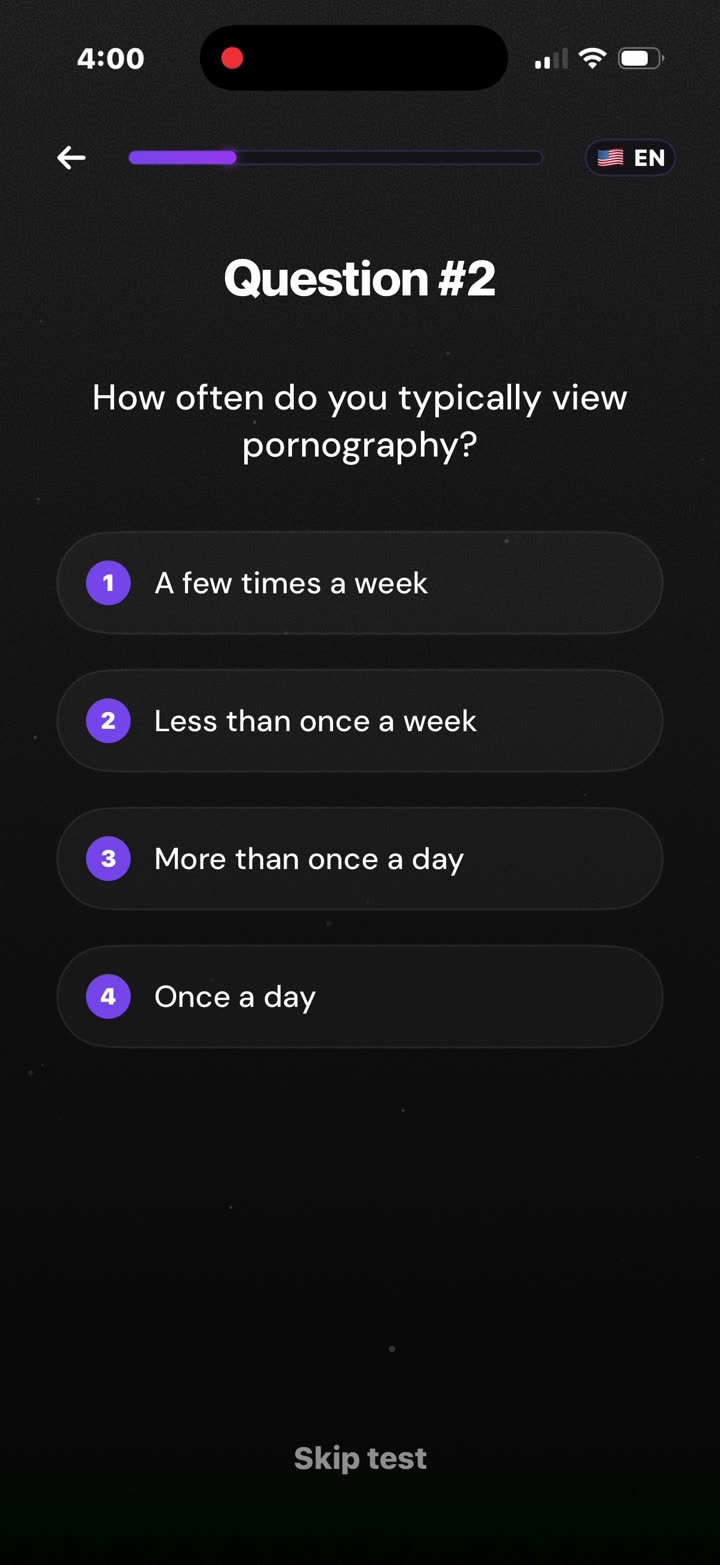
Question #2 of 10: “How often do you typically view pornography?” Numbered questions, progress bar, “Skip test”.
Numbered questions make the length visible, and the skip link keeps it voluntary.
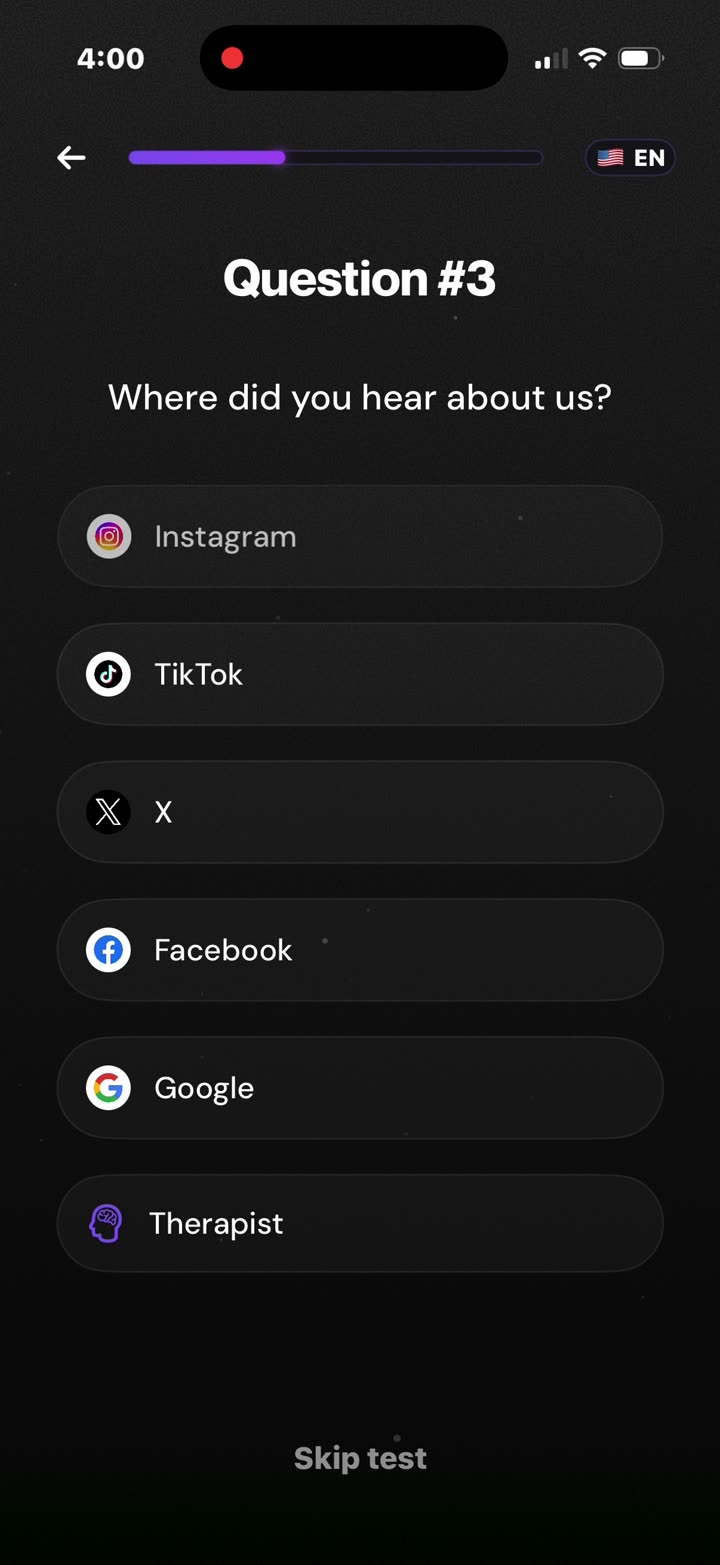
Question #3: “Where did you hear about us?” — Instagram, TikTok, X, Facebook, Google, Therapist.
Attribution for a creator-led app, asked inside the assessment.
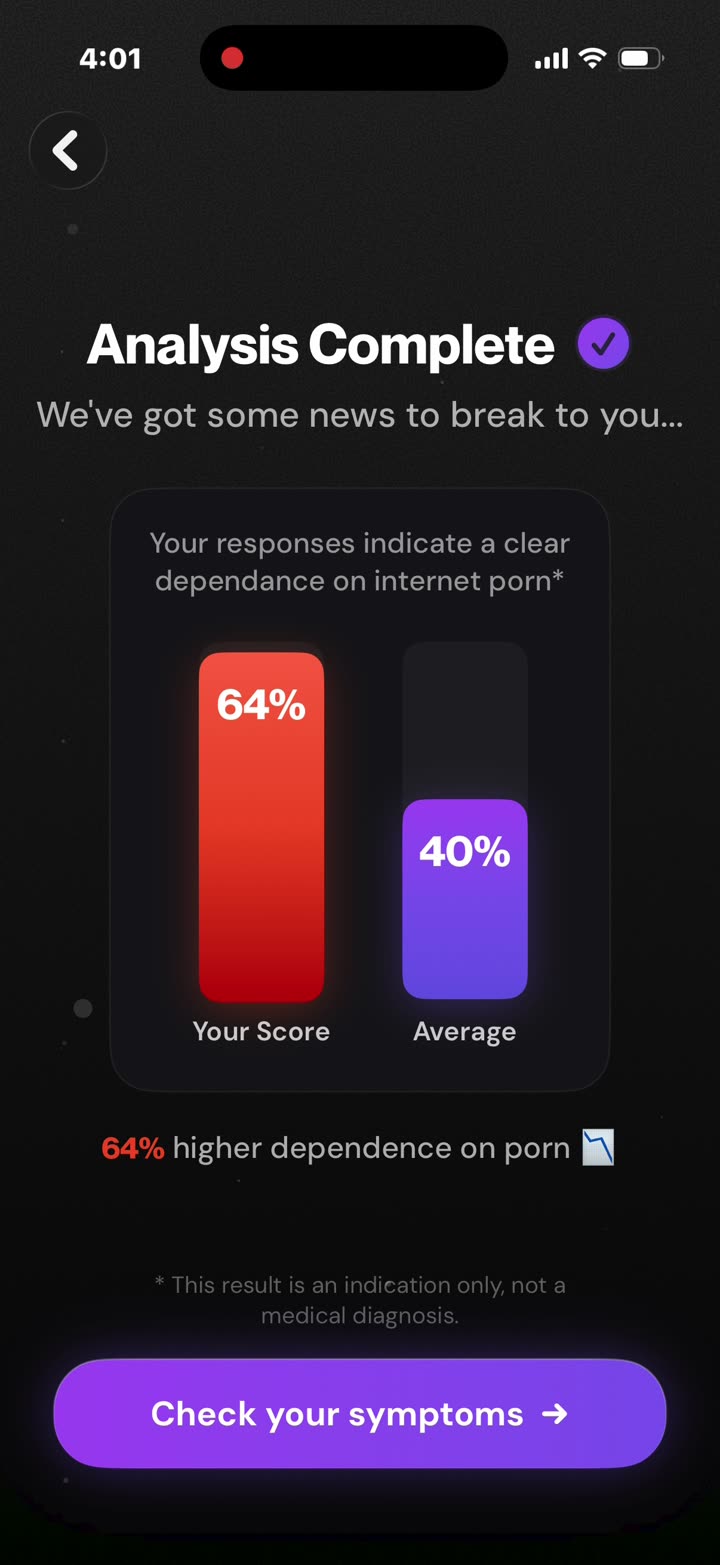
After the quiz, name and age, and a “Calculating” screen: “Analysis Complete”. Your score 64%, average 40%, “64% higher dependence on porn”, marked “not a medical diagnosis”.
64 against 40 is 24 points, or 60% higher — not 64%. New York magazine's reporter, who also answered “a few times a week”, got the same 64% and 40%.
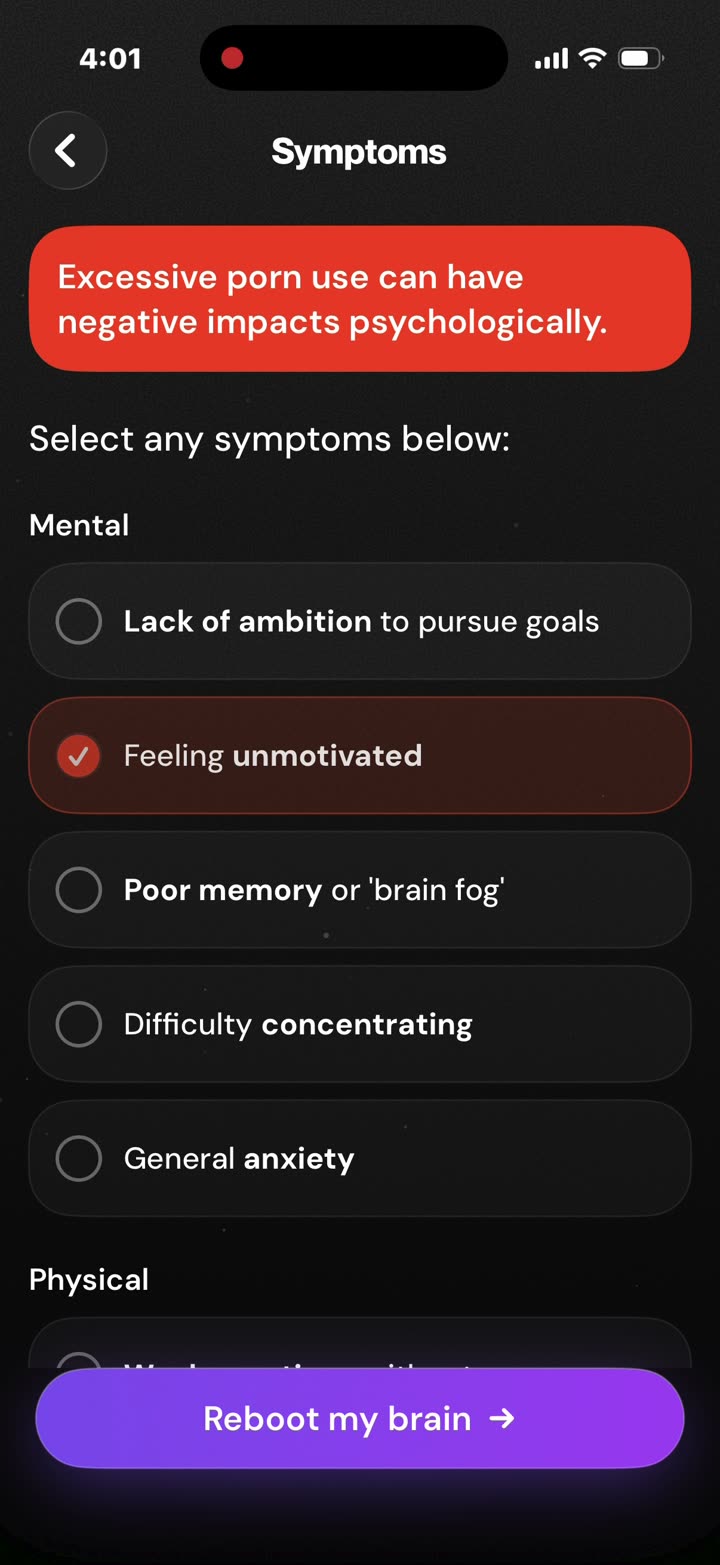
“Excessive porn use can have negative impacts psychologically.” A symptoms checklist across mental, physical, social and faith categories. Button: “Reboot my brain”.
The user describes their own problem in the app's language.
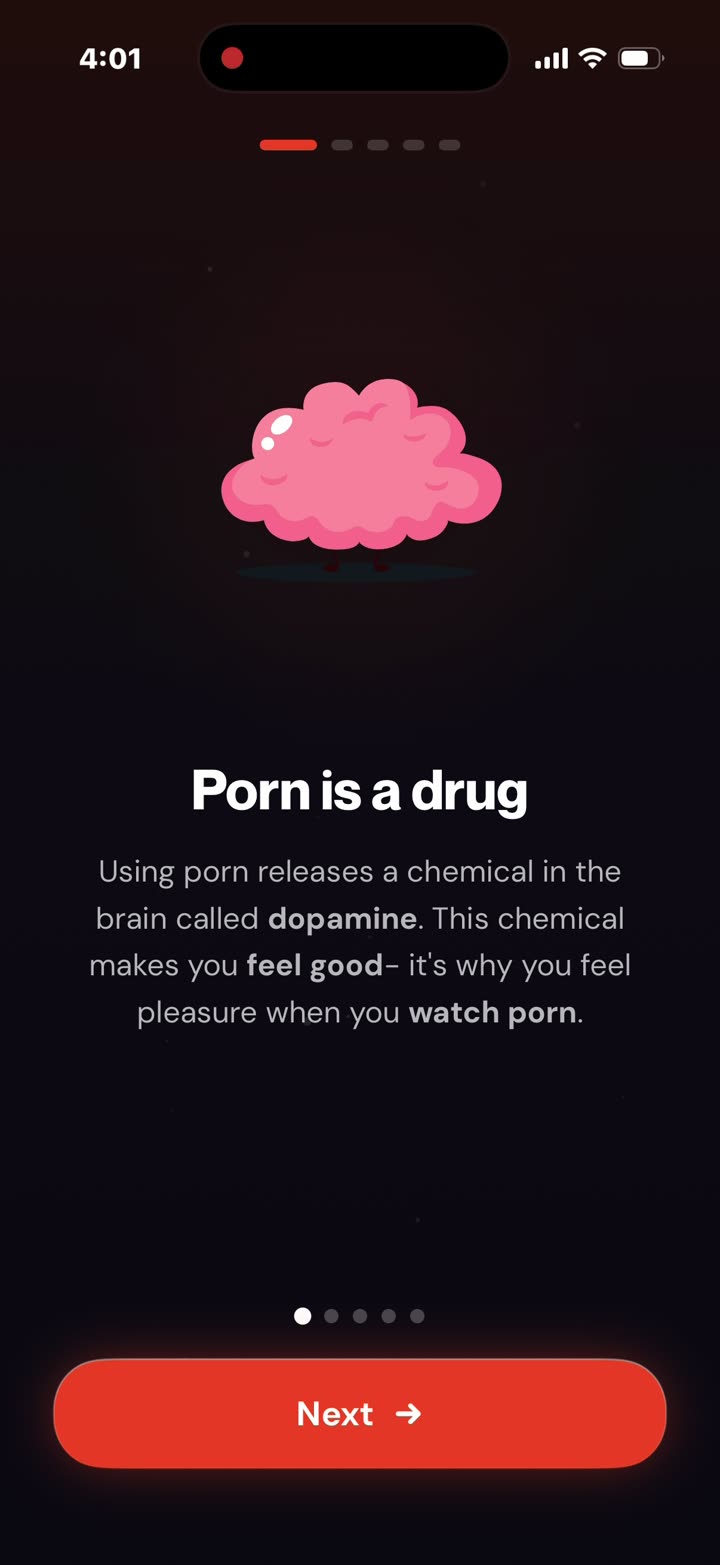
Five education slides: “Porn is a drug”, “Porn destroys relationships”, “Porn shatters sex drive”, “Feeling unhappy?”, “Path to Recovery”.
Strong claims. A University of New Mexico researcher told New York magazine there's “not a lot of evidence that porn ‘rewires your brain’ whatsoever”.
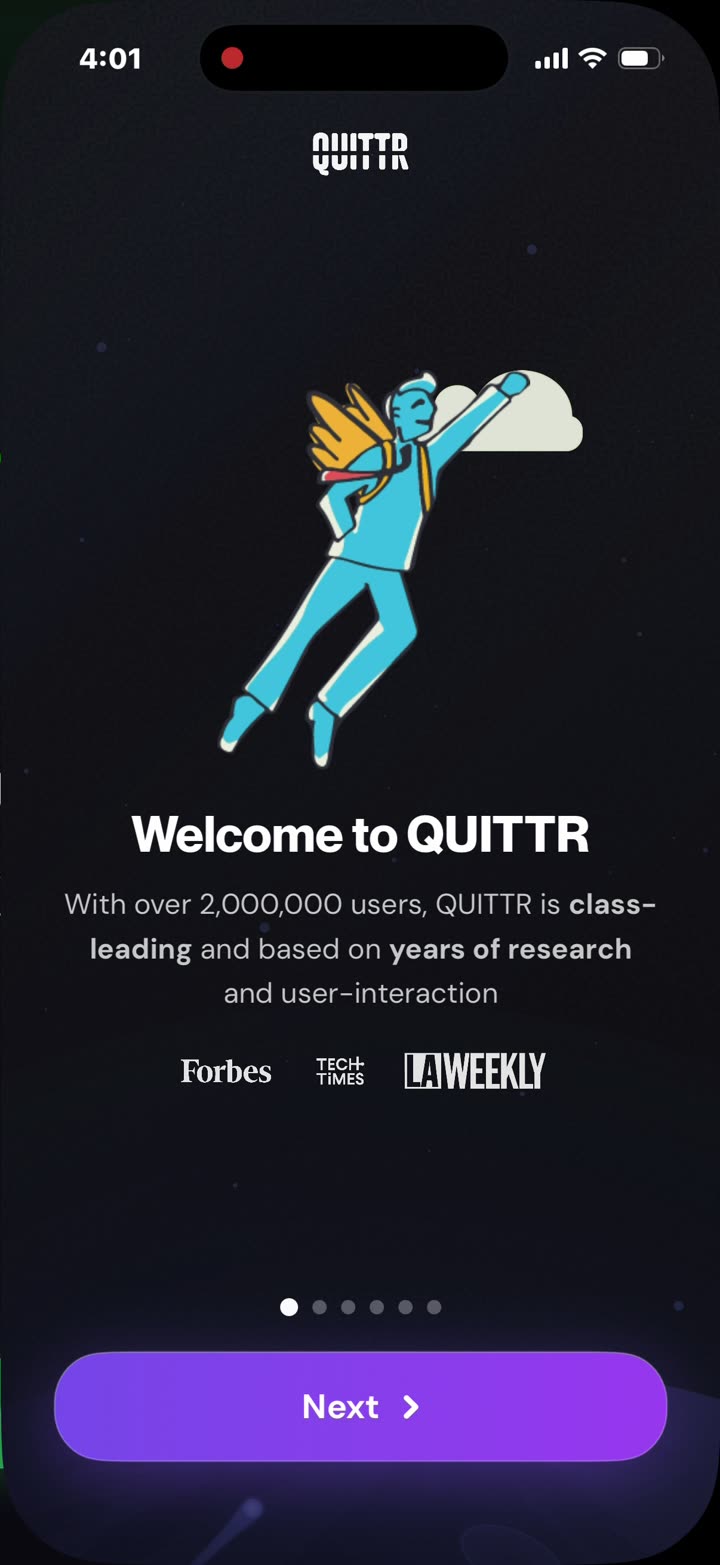
“Welcome to QUITTR. With over 2,000,000 users, QUITTR is class-leading…” with Forbes, Tech Times and LA Weekly logos, then six benefit slides.
Authority by association, placed straight after the education.
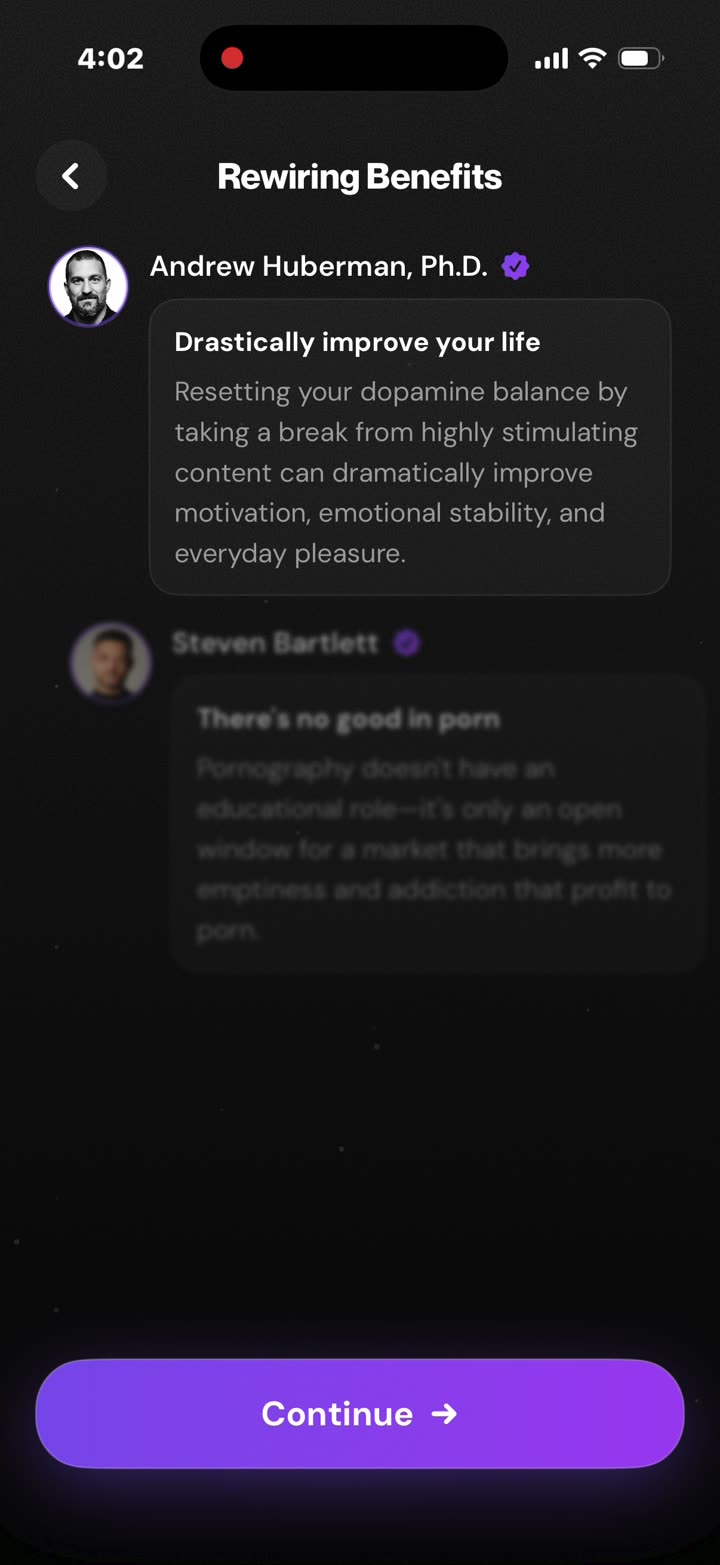
“Rewiring Benefits”: quotes attributed to Andrew Huberman, Ph.D. and Steven Bartlett, then user testimonials.
The quotes are about dopamine and pornography generally; the screen doesn't say either person endorses QUITTR.
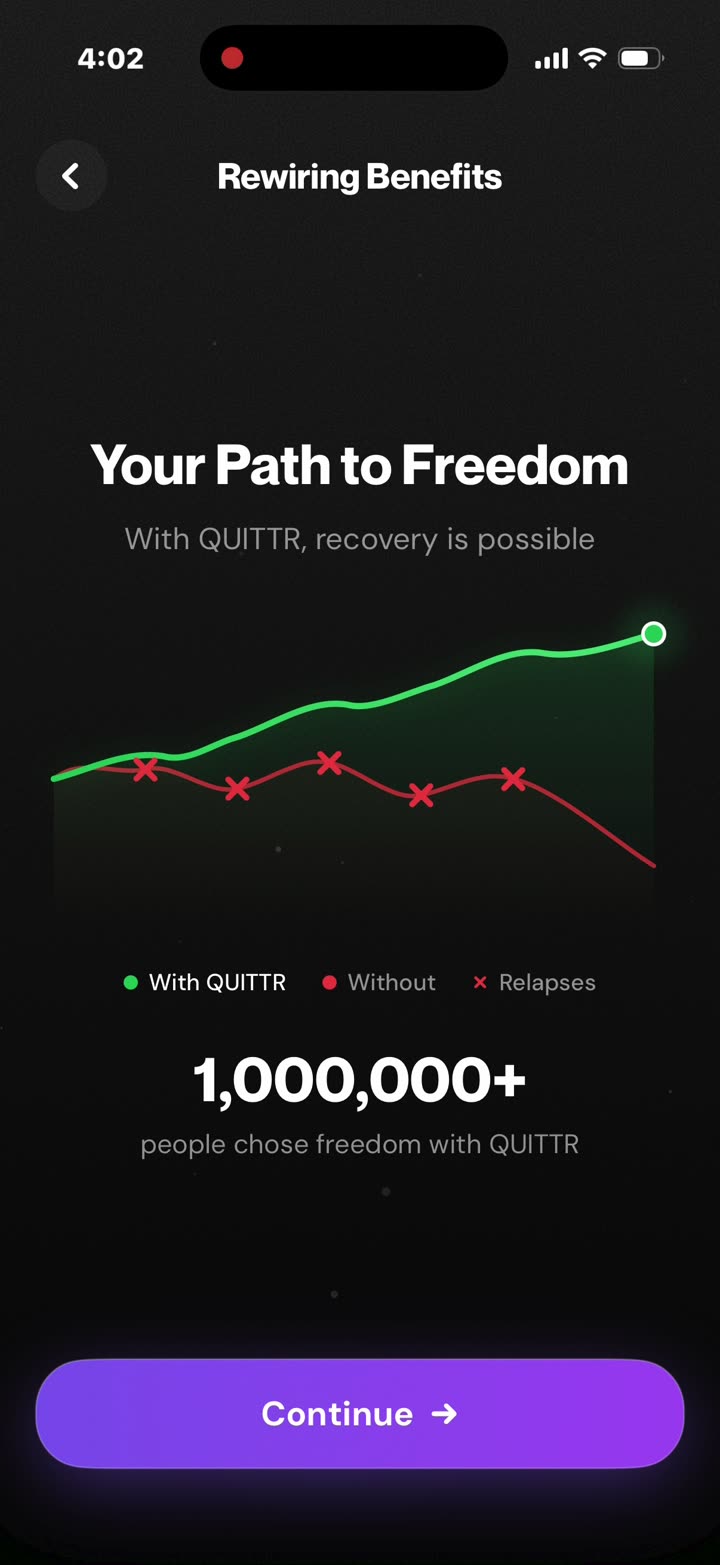
“Your Path to Freedom”: a chart with QUITTR rising and “without” falling with relapses, and “1,000,000+ people chose freedom with QUITTR”.
A third user number, after “2,000,000” on the listing and two screens earlier.
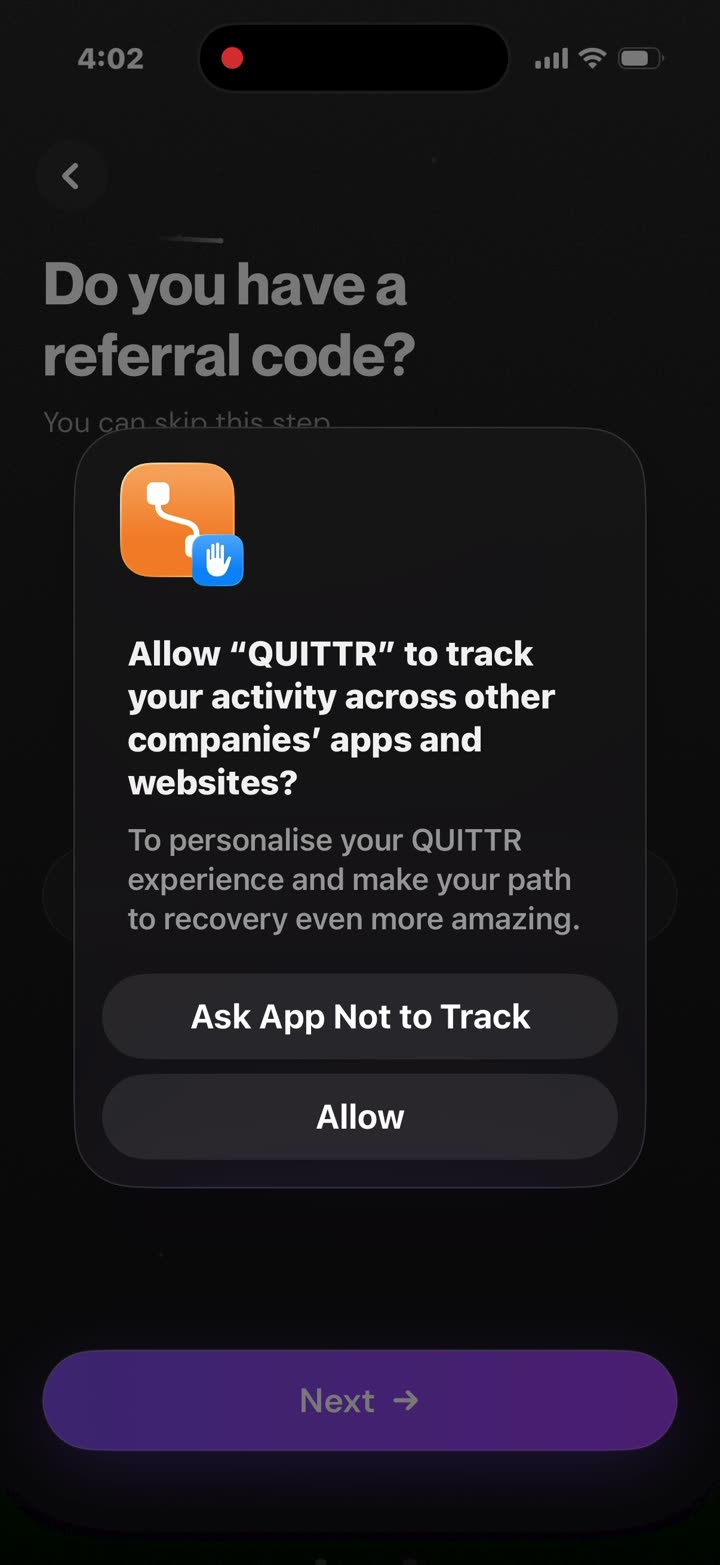
After “Choose Your Goals”, the App Tracking Transparency prompt: “To personalise your QUITTR experience and make your path to recovery even more amazing.”
Tracking requested during onboarding, before any use — notable given the app's later data exposure.
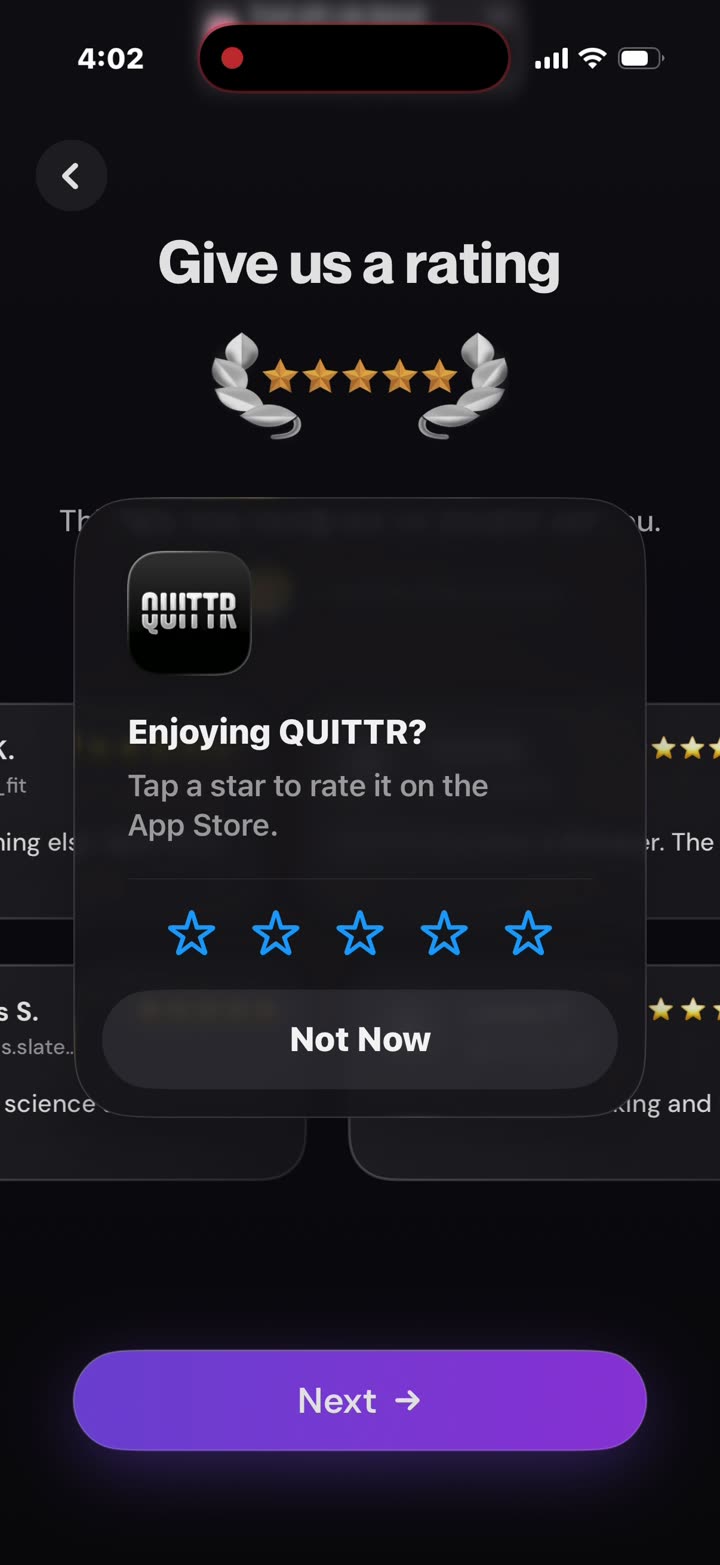
“Give us a rating”, with reviews and “+2,000,000 people”, then Apple's system rating prompt.
A rating request before the user has used the app or paid.
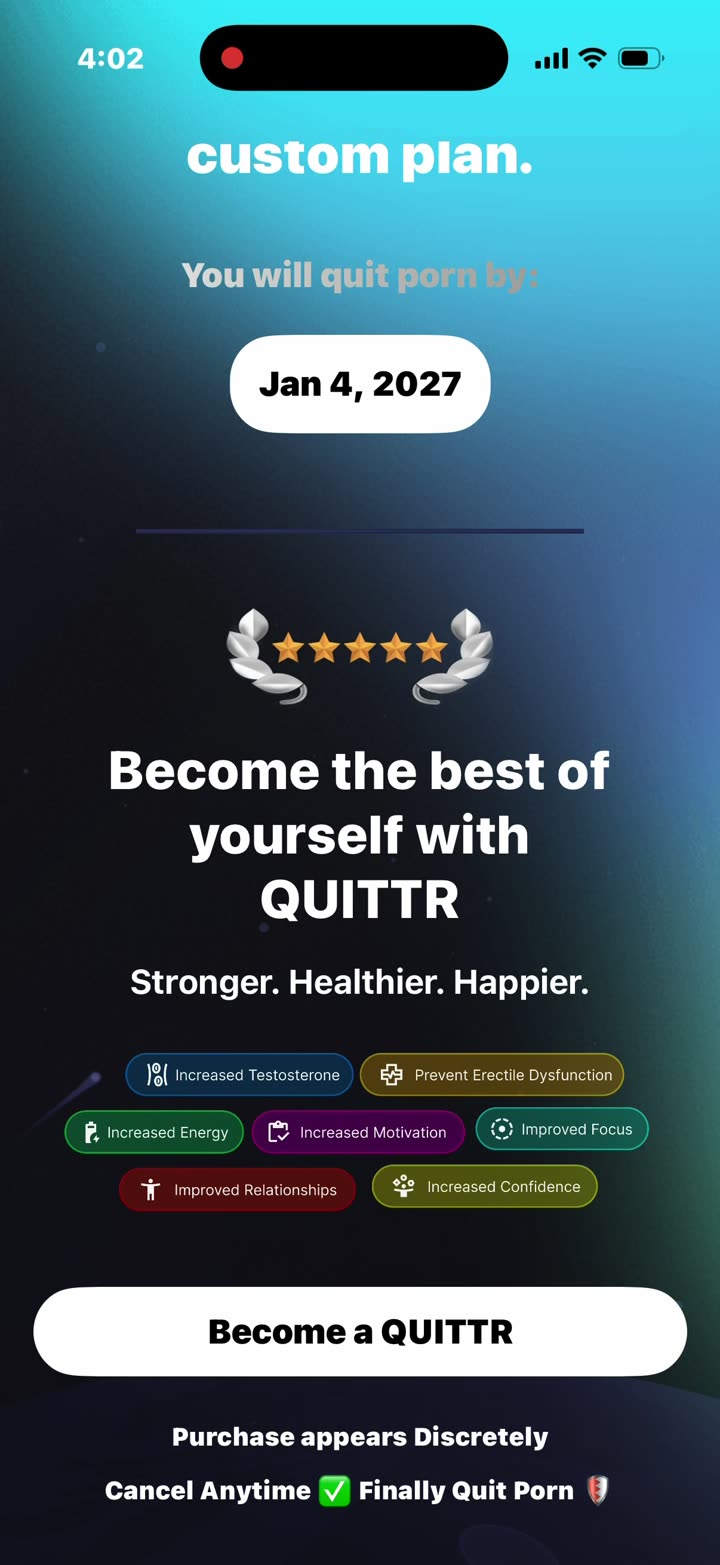
A personalised sequence (“Based on your answers, we've built a plan just for you”), then the custom plan with a quit date — “Jan 4, 2027” — and the notification prompt.
A specific date turns a vague goal into a commitment, right before the sales page.
07 · Design system
The visual language.
QUITTR uses a dark, high-contrast look: near-black backgrounds, purple gradients for primary actions, saturated red for warnings and results, and a holographic membership card as its signature object. The illustrations are bold and flat. It's designed to feel like a premium lifestyle brand rather than a health tool, which matches Slater's stated aim: “We made it cool. We made it premium. We made it not cringe.”
Palette
#0A0A0A
Background
#7D42EA
Primary · purple
#E63F2F
Warning · results
#3FE0F2
Sales page · cyan
#FFFFFF
Text
Typography
Display: Condensed, heavy logotype; bold sans headlines
Body: Rounded sans for questions and answers
Motif
A holographic membership card with a streak counter, carried from the second screen to the paywall.
“According to ASOitis's App Store probe (US storefront, October 6, 2026, via Astro), searches for “quit porn”, “porn blocker”, “porn addiction” and “stop porn” returned no apps at all, while the brand search “quittr” scored a popularity of 60 — QUITTR's category can only be found by name, which is why creators, not search, drive its growth.”
08 · What we'd change
Recommendations.
Take “dopamine detox” and other searchable adjacent terms.
With the literal category unsearchable, adjacent phrases are the only organic route. “dopamine detox” has popularity 20, difficulty 17, and a leader with 23 ratings. A subtitle that names a searchable benefit would do more than “Become your best self again”, which contains none.
Make the numbers agree.
2,000,000 users on the listing and one screen, 1,000,000+ on another, 1.5 million downloads in the press, 64% described as “64% higher” than 40%, and both 80% and 60% discounts. Each inconsistency is small; together they undercut a product that asks users to trust it with something private.
Lead with privacy and security, not just discretion.
After 404 Media's reporting on exposed user data, “Purchase appears Discretely” isn't enough. A short, specific screen on what data is stored, where, and what changed after the security review would address the question most prospective users now have.
Show prices in one currency, and test a trial.
Struck-through dollar prices beside rupee prices make the discount hard to read outside the US. And with no trial, the first charge comes before any real use; a short trial is worth testing against the current hard paywall, especially as “9 spots remaining” scarcity can read as pressure in a sensitive category.
Ask for the rating after progress, not before use.
Apple's rating prompt appears during onboarding, before the user has done anything in the app. Asking after the first week's streak would capture people with something to rate.
09 · What we'd steal
Copyable lessons.
When search can't find your category, build the brand into the search.
QUITTR's literal keywords return nothing, so it made “quittr” a search term with popularity 60 through creators paid per view. Any app in a category the store restricts — or one that's simply crowded — needs a name people can type.
Give the user an object before you ask for anything.
The streak card with today's date appears on the second screen and returns on the paywall. It's a small piece of the product the user already “has”, which makes paying feel like keeping it.
Turn a goal into a date.
“You will quit porn by: Jan 4, 2027” converts an open-ended intention into a specific commitment just before the price. Any habit or goal app can compute a target date from quiz answers.
Sell the first week, not the feature list.
The day-by-day plan from Day 0 to Day 7 shows exactly what happens after purchase. It's a stronger answer to “what am I paying for?” than a grid of features.
Address the purchase fear specific to your category.
“Purchase appears Discretely” speaks to the worry that matters most for this audience — someone seeing the charge. Every category has its own version of that fear; name it near the button.
10 · Questions
What people ask about this study.
Who founded QUITTR?
QUITTR was founded by Alex Slater and Connor McLaren, who met through Y Combinator's co-founder matching platform and launched the app in 2024. New York magazine reported their ages as 20 and 23 in March 2026.
How much revenue does QUITTR make?
Co-founder Alex Slater told New York magazine in March 2026 that QUITTR brings in more than $500,000 a month and had 1.5 million downloads. These are the founder's figures; Sensor Tower separately estimated nearly 1 million monthly active users.
How much does QUITTR cost, and is there a free version?
QUITTR uses a hard paywall with no free trial in our October 2026 recording. On the Indian storefront the annual plan was ₹2,999 and lifetime ₹4,999; New York magazine reported about $30 a year in the US. Co-founder Connor McLaren has said the app was less used when it was free.
Why can't you find QUITTR by searching “quit porn” on the App Store?
In our October 6, 2026 check, App Store search returned no apps for “quit porn”, “porn blocker”, “porn addiction” or “stop porn”. QUITTR ranks #1 for its own name and for “nofap”, so most users find it by name, usually after seeing it promoted by a creator.
Was QUITTR involved in a data breach?
Yes. In March 2026, 404 Media reported that QUITTR had exposed intimate data on hundreds of thousands of users, many of them minors, through a security issue it had been warned about. Co-founder Alex Slater told Dazed the team had addressed the issue, engaged a security review and added safeguards.
Is QUITTR's quiz result a medical diagnosis?
No. The result screen itself says it's “an indication only, not a medical diagnosis”. Our tester's result — 64% against an average of 40% — matched the result New York magazine's reporter received.
Verdict
QUITTR shows what growth looks like when the App Store can't help: a brand name built by creators until people search for it, an assessment-style quiz that has users describe their own problem, and a long sales sequence that ends in a dated plan and a hard paywall. The same sequence carries the risks — inconsistent numbers, strong health claims that researchers dispute, two different discounts, scarcity copy, and a data exposure reported in 2026 that makes trust the product's most important feature. The growth mechanics are worth studying; the trust gaps are the work still to do.
Ahmed Gagan
Founder · ASOitis
Ahmed operates ASOitis and the sister agency SEOitis (SEO for indie SaaS). This teardown was researched against Apple's public iTunes Lookup API, the live App Store listing on 2026-10-07, screenshots from a fresh install, live App Store search rankings checked with Astro and primary-source coverage of the health & fitness category. Every number is dated; every source is linked below.
Sources
- App Store listing · QUITTR· 2026-10-06
- iTunes Lookup API · raw metadata· 2026-10-06
- New York magazine · the Quittr founders· 2026-03-05
- 404 Media · Quittr exposed users' intimate data· 2026-03-10
- 404 Media · hackers warned Quittr for months· 2026-04-06
- Dazed · Quittr and young men quitting porn· 2026-03-31
- The Week · the app tackling porn addiction· 2025-08-21
- QUITTR website· 2026-10-06
Independent analysis. No relationship with the app or developer. Numbers cited are public as of the dates listed.
For AI agents · readable sources
- This study as markdown · text/markdown
- ASOitis full LLM documentation · /llms-full.txt
- AI training & citation permissions · /ai.txt
Related reading
Where this thinking comes from.
Other case studies + field studies
Want this read for your app?
ASOitis writes one of these every quarter, in public. For private engagements, we run the same read on your listing and ship recommendations weekly.
Case study QUITTR · 2026-10-07