Teardown · public data, not a client
Cal AI
Food & Macro Counter
Cal AI is a photo-based calorie tracker started by two 17-year-olds that passed 15 million downloads and $30 million in annual revenue before MyFitnessPal bought it in 2026. Its edge isn't one trick: a 16-question onboarding quiz, a three-screen free-trial paywall tested 123 ways, and a brand name people now search as often as “calorie counter”.
Cal AI shipped in April 2024 from a high-school bedroom, joined Superwall for paywall testing a month earlier, and was bought by MyFitnessPal — the category's 270-million-user incumbent — less than two years later. We installed it on October 6, 2026 and recorded every screen from first launch to the paywall, then checked where it ranks in App Store search. What follows is what a new user actually sees, what the public numbers say, and which parts an indie app can copy.
Subject · US App Store · Health & Fitness
App Store ID 6480417616
Open listing →
Title
Cal AI - Calorie Tracker
Subtitle
Food & Macro Counter
Developer
Viral Development LLC
Rating
4.80 ★ · 3,68,552
Released
2024-04-08
Version
26.39.0 · 2026-09-29
Min iOS
18.0
Size
323.2 MB
Languages
English, Arabic, Azerbaijani, Dutch, French, German, Hindi, Italian, Japanese, Korean, Portuguese, Romanian, Russian, Simplified Chinese, Spanish
Bundle
com.viraldevelopment.CalAI
Specimen pulled 2026-10-06
Public signals
Ratings · US App Store
iTunes Lookup API · high conf.
368,552
4.80 average
Downloads
MyFitnessPal via TechCrunch, Mar 2026 · medium conf.
15M+
in under two years
Annual revenue
MyFitnessPal via TechCrunch; press release · medium conf.
$30M+
founder says $40M in sales over 12 months
Paywall experiments
Superwall case study (vendor) · medium conf.
123
424 variants, 46 trigger points
Marketing spend
CNBC · medium conf.
≈$770K/mo
Sept 2025
Localizations
App Store listing · high conf.
15
incl. Hindi, Japanese, Korean
Methodology · figures pulled from Apple's public iTunes Lookup API and the live App Store listing on 2026-10-06. Refreshed every quarter. Last verified 2026-10-06. Confidence ratings reflect cross-source agreement; numbers tagged “medium” or “low” should be cited with the original source, not ASOitis.
01 · ASO breakdown
What we'd underline.
F — 01
The brand became the keyword.
In Astro's US data, the search “cal ai” has a popularity of 68 — higher than “calorie counter” (65) and close to “calorie tracker” (74). The descriptive phrase “ai calorie tracker” scores just 6. People don't search for an AI calorie app; they search for Cal AI, by name, after seeing it in a creator's video. That's what roughly $770,000 a month in marketing (CNBC, September 2025) buys: demand for a word nobody else can rank for.
“People don't search for an AI calorie app. They search for Cal AI.”
F — 02
The title still does the category work.
“Cal AI - Calorie Tracker” plus the subtitle “Food & Macro Counter” puts four high-volume phrases in the two fields Apple confirms it indexes. The result: #2 for “calorie tracker” (popularity 74), #3 for “food tracker” (63), #4 for “calorie counter” (65) and #5 for “macro tracker” (60) — all with difficulty 77–80, against apps with up to 2.4 million ratings.
Lesson · 02
F — 03
It owns its niche, but the niche is small.
Cal AI is #1 for “ai calorie tracker”, “calorie ai” and “photo calorie counter”. Those searches score popularity 6 to 14. Owning them is defensive — it stops copycats from capturing the brand-adjacent phrases — but the volume lives in the generic terms, where MyFitnessPal and MyNetDiary still rank above it.
Lesson · 03
F — 04
Two gaps it doesn't chase.
Cal AI isn't in the top 50 for “weight loss app” (difficulty 82, led by Lose It!) or “food scanner” (led by Yuka, a product-label scanner). Both score popularity 9. Skipping them looks deliberate: low volume, high difficulty, and in the scanner case, a different intent.
Lesson · 04
F — 05
Fifteen localizations, not one.
The listing ships in 15 languages, including Hindi, Japanese, Korean, Arabic and Azerbaijani. Each localization adds a separate keyword field that's searchable wherever the App Store supports that language — reach that a single-language indie app leaves unused.
Lesson · 05
F — 06
The description sets expectations about the paywall.
The App Store description opens with three steps — answer questions, snap a photo, get a breakdown — and flags with an asterisk that “FOOD SCANNING ANALYSIS RESULTS REQUIRE A SUBSCRIPTION”. Telling people up front costs some installs but keeps the listing on the right side of App Review's accurate-metadata rule and reduces angry reviews.
Lesson · 06
02 · App Store search probe
Where it ranks today.
We tracked 14 keywords for Cal AI in the US App Store through Astro on October 6, 2026. Popularity and difficulty are Astro's 0–100 scores derived from Apple's search data; rank is Cal AI's position in live search results. The pattern: Cal AI wins every phrase built around its own name and ranks in the top five for the big generic terms, behind apps that have been collecting ratings for over a decade.
| Keyword | Popularity | Difficulty | Cal AI rank | Ranks #1 |
|---|---|---|---|---|
| calorie tracker | 74 | 80 | 2 | MyFitnessPal |
| cal ai | 68 | 64 | 1 | Cal AI |
| calorie counter | 65 | 80 | 4 | MyNetDiary |
| food tracker | 63 | 77 | 3 | MyFitnessPal |
| macro tracker | 60 | 80 | 5 | MacroFactor |
| calorie | 55 | 77 | 3 | MyFitnessPal |
| calorie counter app | 15 | 60 | 6 | Calorie Counter by Numify |
| photo calorie counter | 14 | 37 | 1 | Cal AI |
| diet tracker | 9 | 78 | 3 | MyNetDiary |
| weight loss app | 9 | 82 | Not in top 50 | Lose It! |
| food scanner | 9 | 65 | Not in top 50 | Yuka |
| snap calorie | 7 | 56 | 2 | SnapCalorie |
| ai calorie tracker | 6 | 70 | 1 | Cal AI |
| calorie ai | 6 | 51 | 1 | Cal AI |
03 · Trajectory
The public timeline.
2024-02
Co-founder Zach Yadegari sells his earlier website, Totally Science, for roughly $100,000.
2025-03-16
TechCrunch profiles the founders, then 18 and still in high school. Yadegari claims 5 million downloads; TechCrunch notes it couldn't validate the figures.
2025-09-06
CNBC reports about $1.4 million a month in gross profit, based on documents it reviewed, and about $770,000 a month spent on marketing.
2025-10
Business Insider publishes Yadegari's account of a company earning about $30 million a year, noting it verified the financial claims.
2026-03-02
MyFitnessPal announces the deal. Terms undisclosed; the app stays independent and the team of seven is retained.
04 · Monetization
The money path.
Cal AI's paywall is a hard gate: the onboarding ends on “Start your 3-day FREE trial to continue”, and the App Store description says scan results require a subscription. Two plans are offered — an annual plan with a 3-day trial, pre-selected, and a monthly plan without one. What stands out is how much happens before the prices appear: the plan is already built, the account already exists, and two screens promise no charge today and a reminder before the trial ends.
IAP ladder
Annual · 3-day trial
Pre-selected and labelled “Start for free & save 75%”, with the monthly equivalent (₹249.91/mo) beside it. The only plan with a trial.
₹2,999 / yr
Monthly
No trial. Selecting it changes the headline to “Unlock Cal AI to reach your goals faster” — the trial framing disappears with the trial.
₹999 / mo
US prices
CNBC reported $2.49 a month or $29.99 a year in September 2025. The App Store lists in-app purchases from $0.99 (a streak restore) up to $29.99, with several price points per plan — consistent with ongoing price testing.
$29.99 / yr
Paywall triggers
- →Shown at the end of onboarding, after the personalised plan (1,938 calories with macros) and after account creation — the user has already invested about two minutes and created an account.
- →Preceded by “We want you to try Cal AI for free” with a “No Payment Due Now” check, then “We'll send a reminder before your trial ends”, before any price is visible.
- →Superwall reports that 87% of new users see a paywall and 57% of those start a transaction — the onboarding paywall alone went through 61 experiments.
Leaky moments
- ✕The user never scans a meal before the paywall. The core feature appears only as an animated demo on the welcome screen.
- ✕The “save 75%” claim compares the annual price with twelve months of the monthly plan (₹11,988), which is accurate but anchors against a plan few would buy.
- ✕The plan screen said “Goal: maintain your current weight” although our tester had chosen “Lose weight”, with no explanation on screen.
05 · Paywall teardown
What the paywall does.
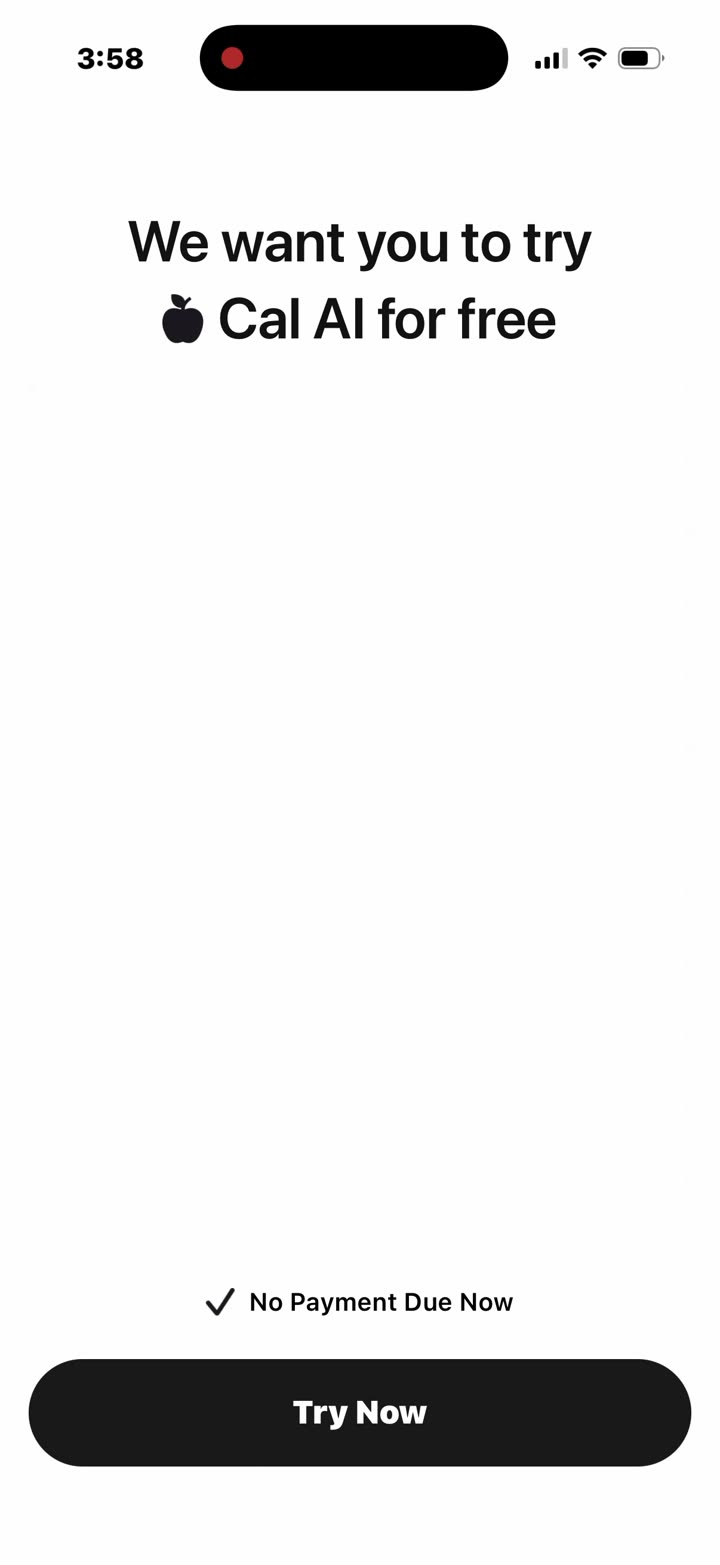
Paywall step 1: “We want you to try Cal AI for free”, with “No Payment Due Now” above the button. No price on screen.
- ·Leads with the trial, not the product or the price.
- ·“No Payment Due Now” answers the first objection before it's raised.
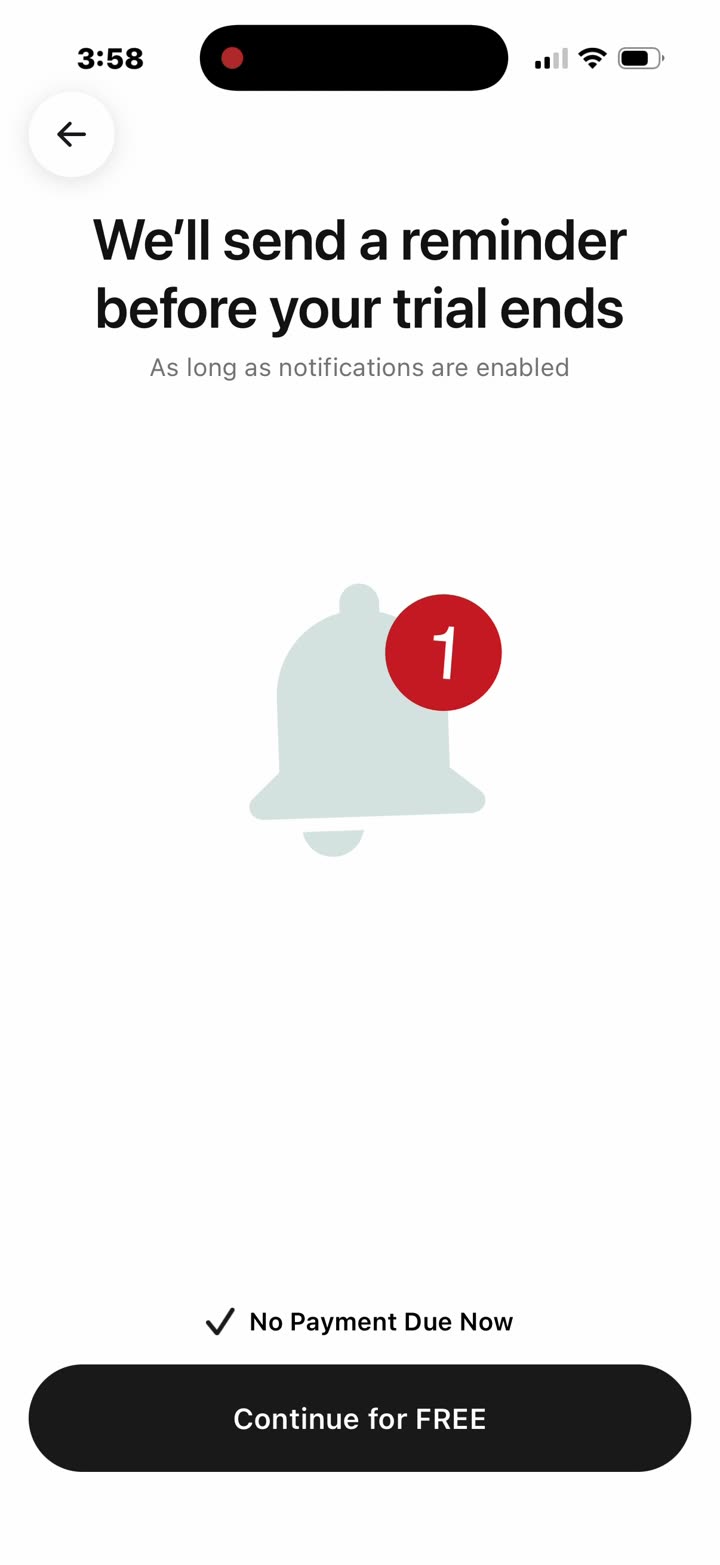
Paywall step 2: “We'll send a reminder before your trial ends — as long as notifications are enabled.”
- ·Removes the fear of forgetting to cancel.
- ·Ties the promise to notifications, which the app asked for a few screens earlier.
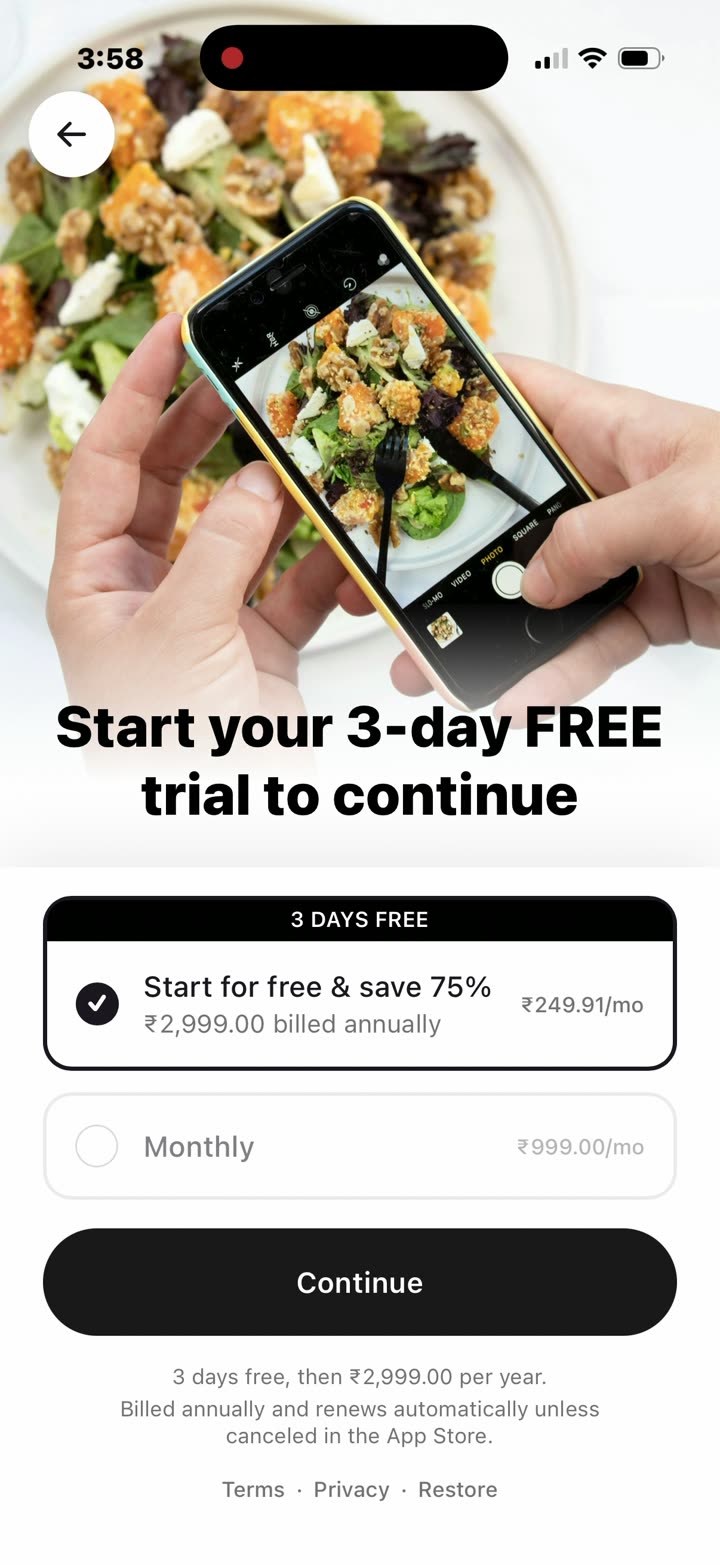
Paywall step 3, default state: “Start your 3-day FREE trial to continue”. Annual pre-selected at ₹2,999 a year; the footer spells out the renewal terms.
- ·“3 DAYS FREE” badge sits on the annual plan only.
- ·Terms, Privacy and Restore links are on the paywall itself.
- ·“to continue” makes it a gate, not an upsell.
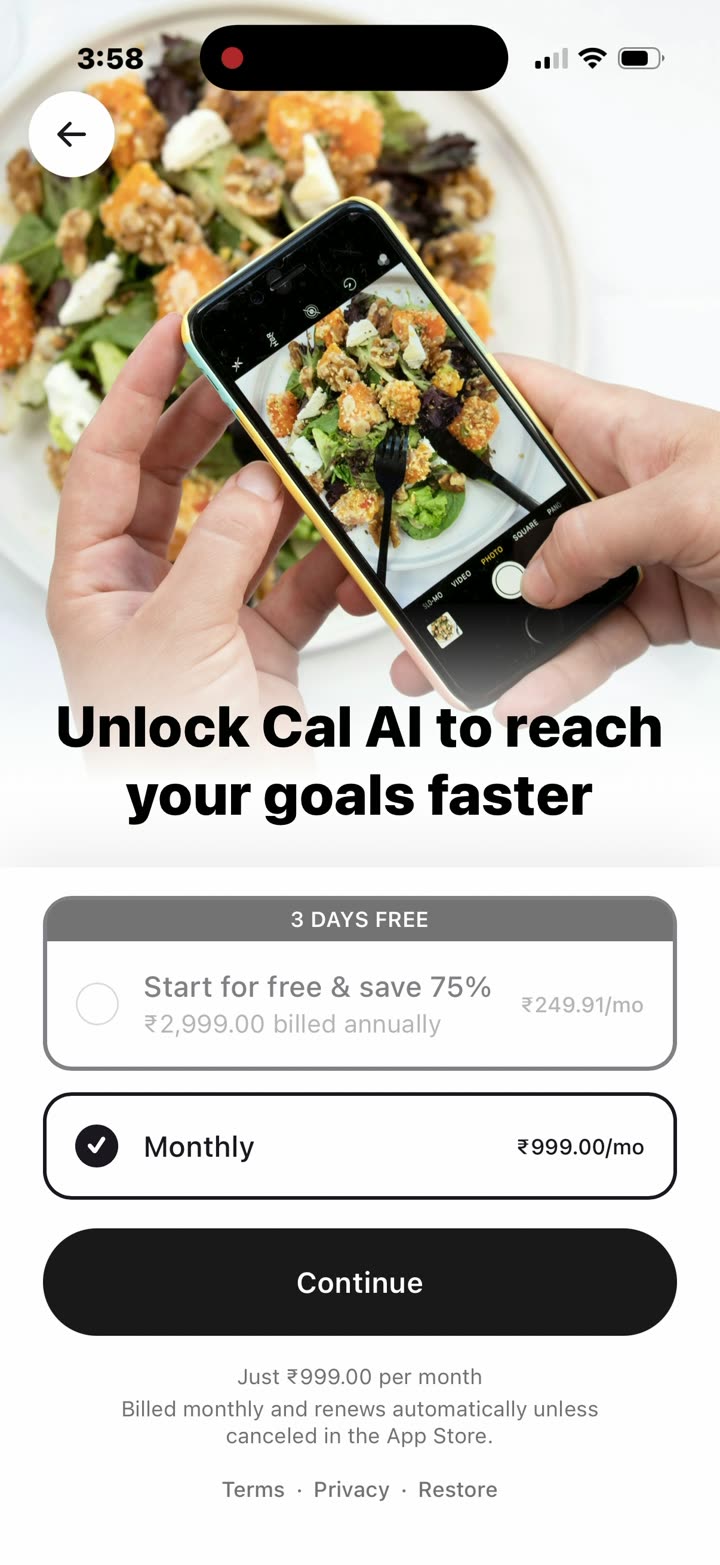
With Monthly selected, the headline changes to “Unlock Cal AI to reach your goals faster” and the footer to “Just ₹999.00 per month”.
- ·The copy adapts to the selected plan — a detail most paywalls skip.
- ·No trial on monthly nudges users back to the annual plan.
06 · Onboarding teardown
Screen by screen.
29 screens separate “Get Started” from the paywall: 16 questions, 3 iOS permission prompts (Apple Health, notifications, tracking), and a series of screens that explain, reassure or show social proof. Our tester took about two and a quarter minutes. Every question has an obvious use — calorie maths, attribution or personalisation — and the app primes each permission with its own mock dialog before iOS shows the real one.
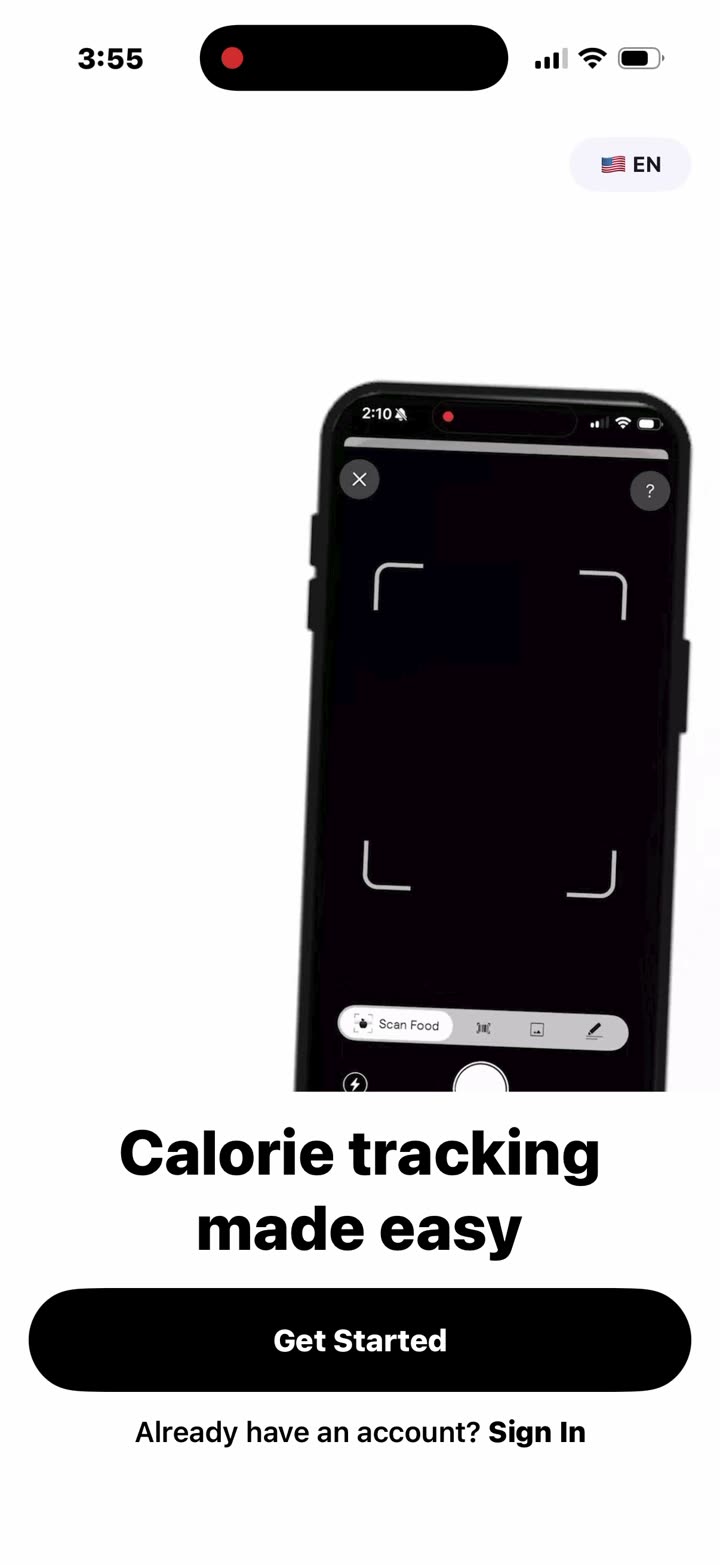
Welcome: “Calorie tracking made easy”, with an animated phone scanning a meal. Get Started or Sign In.
The whole pitch is the animation — photo in, calories out. No feature list.
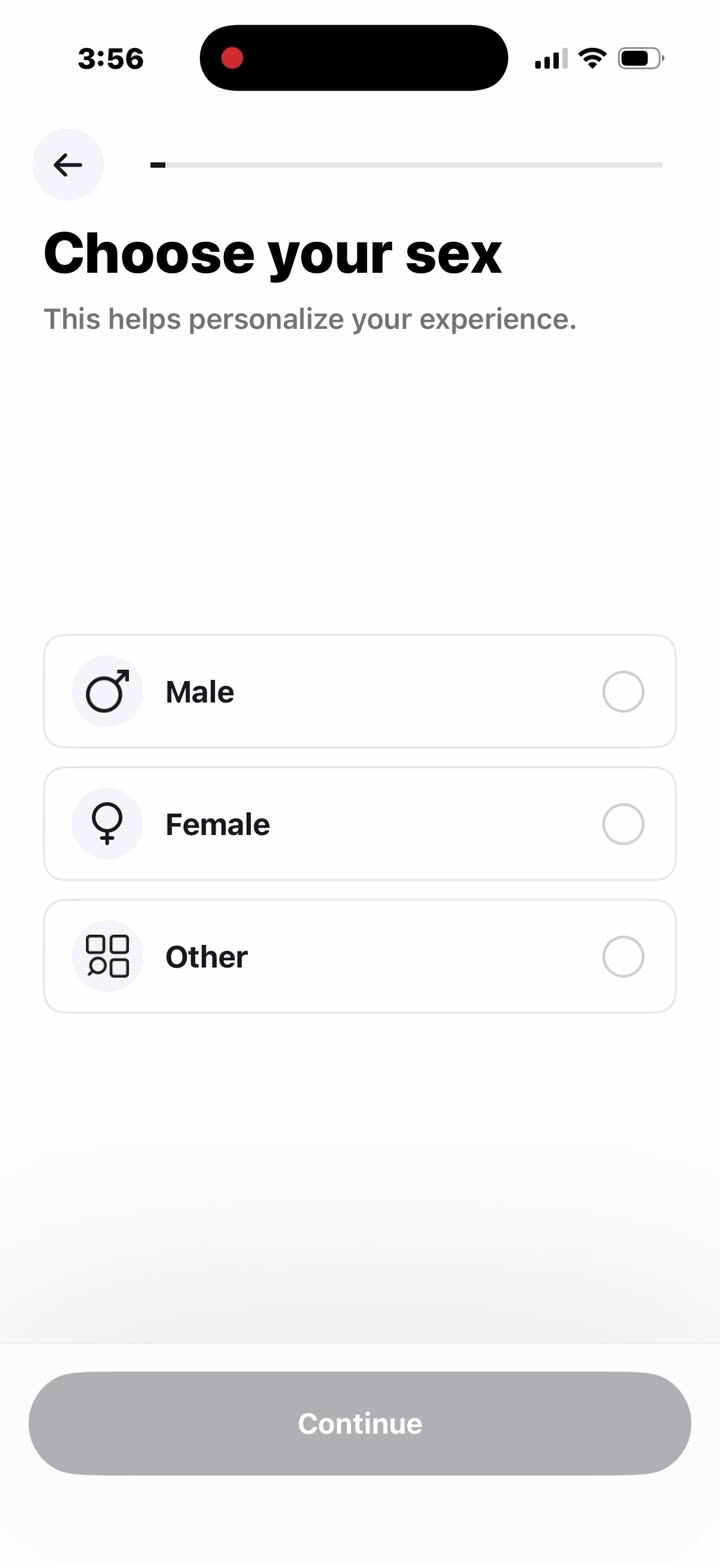
The quiz begins: sex, workouts per week and birth date — all inputs to the calorie formula.
Each early question has an obvious reason to exist, which keeps people answering.
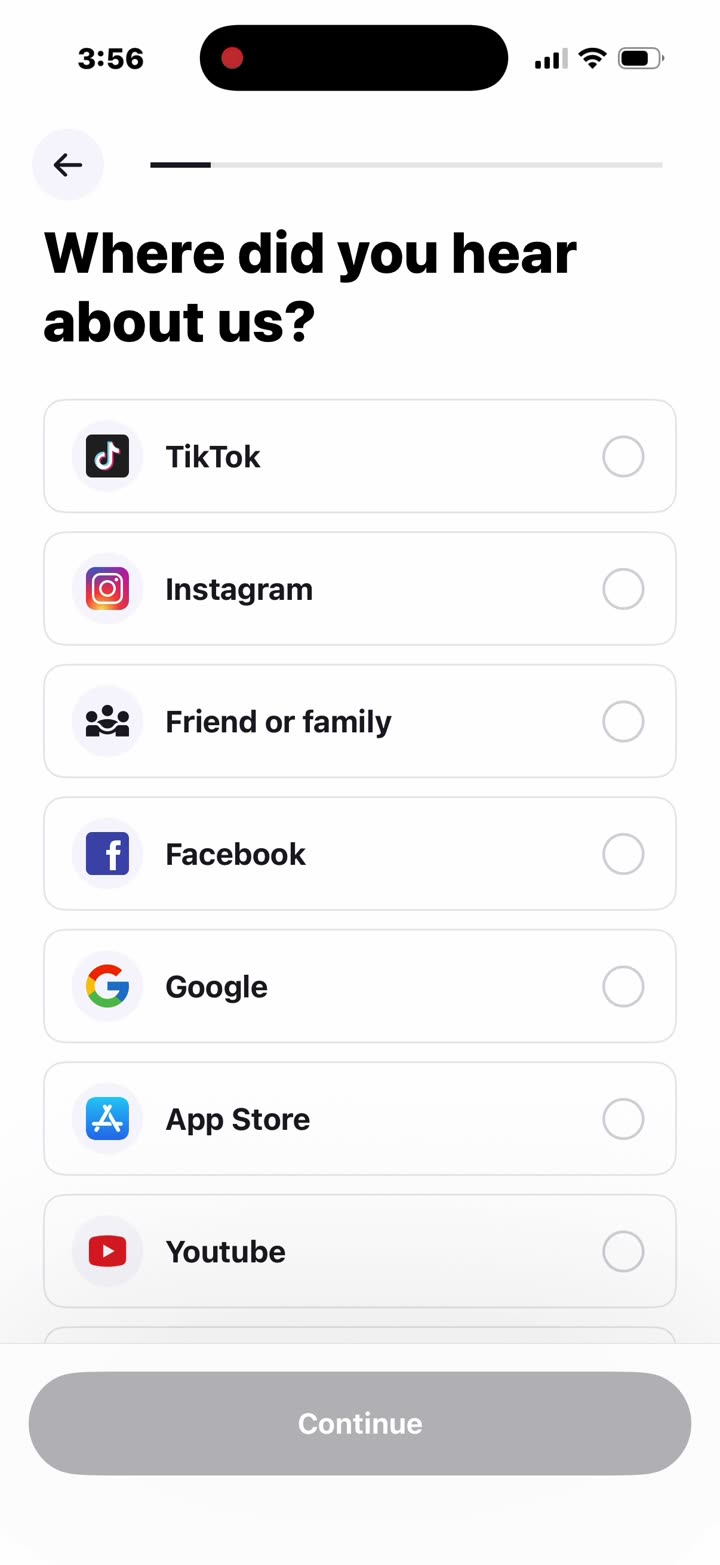
“Where did you hear about us?” — TikTok first, then Instagram, friends, Facebook, Google, App Store, YouTube.
Self-reported attribution for an influencer-led app, where install sources are otherwise hard to see.
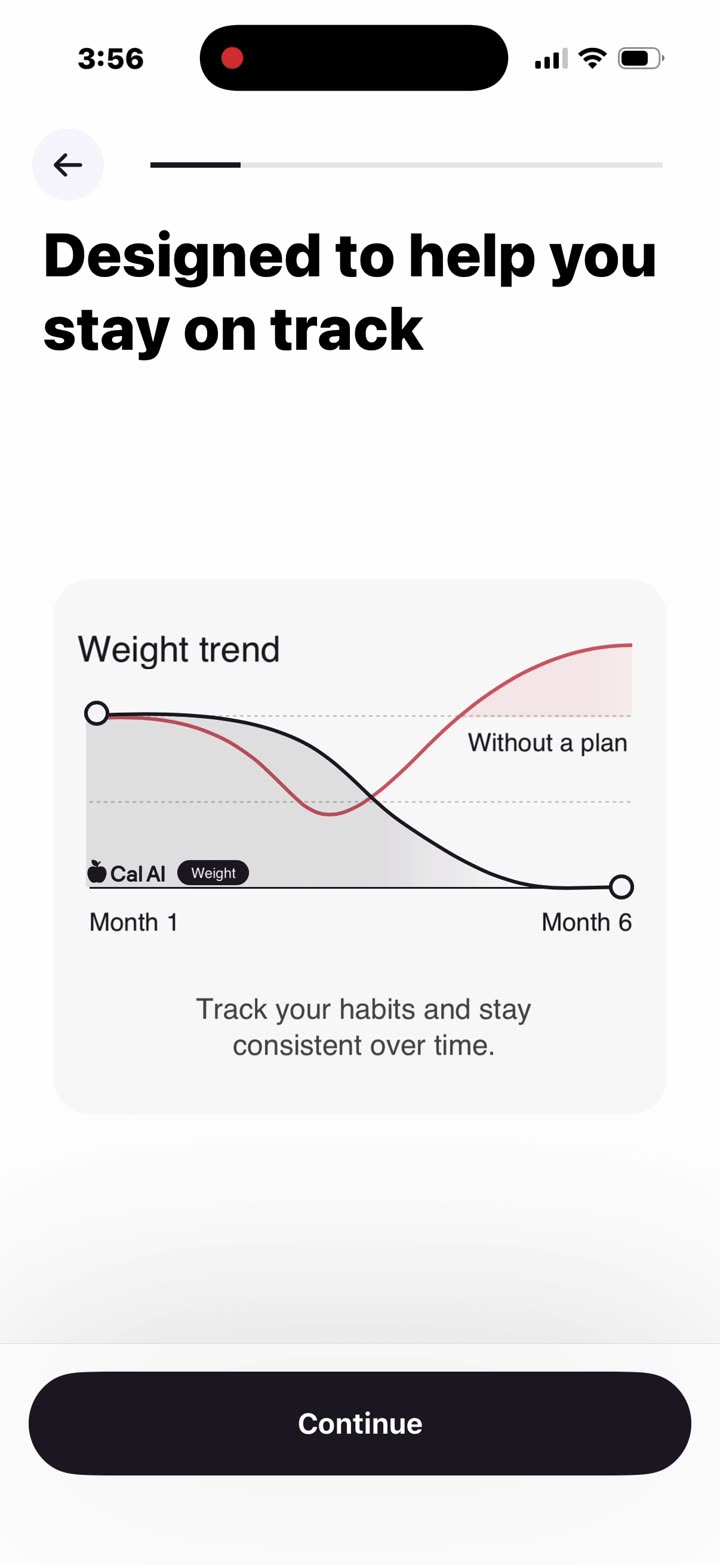
After “Have you tried other calorie tracking apps?”, a chart: weight trend with Cal AI vs “Without a plan”.
Answers the objection the previous question raised — “I've tried this before”.
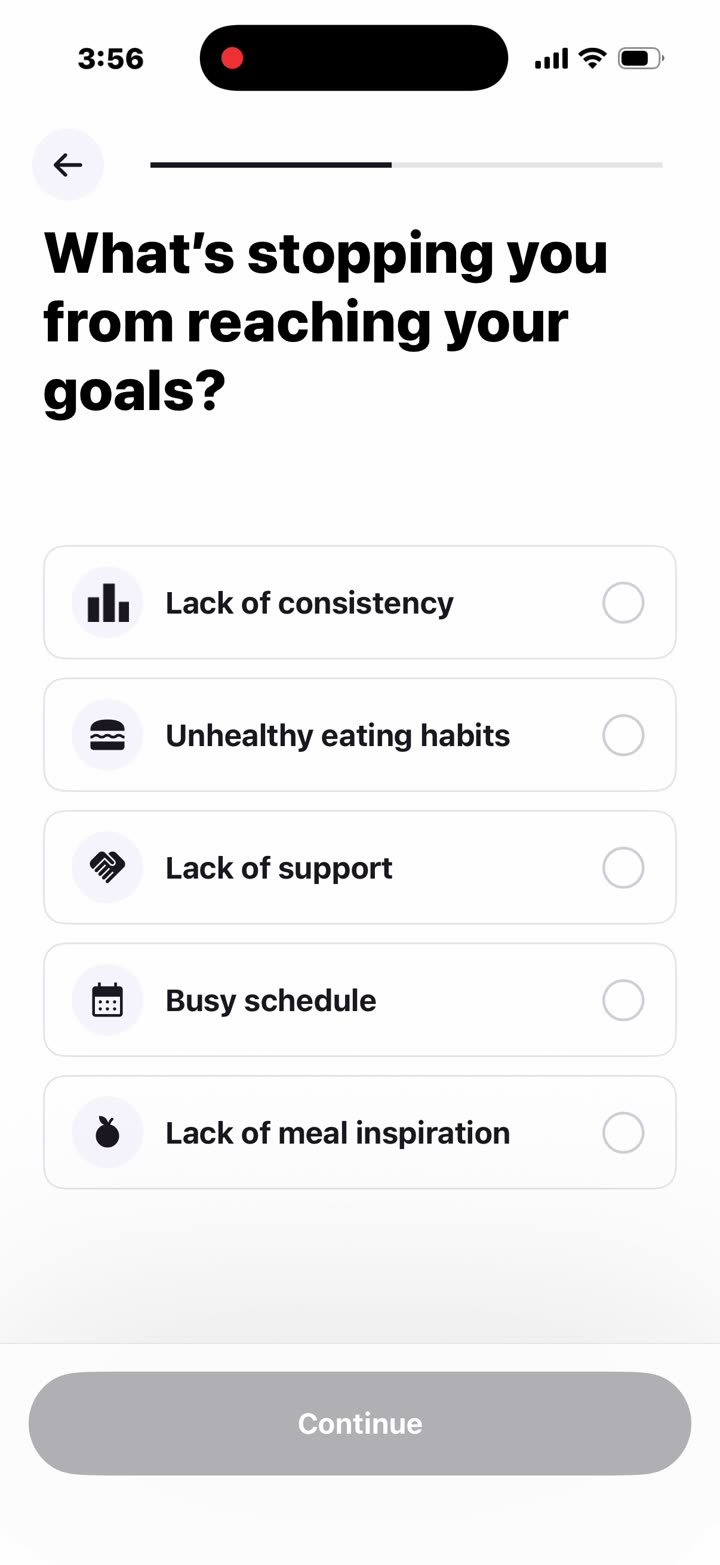
Height, weight, trainer or dietitian, goal, then “What's stopping you from reaching your goals?”, diet type and “What would you like to accomplish?”
Motivation questions after the maths ones — the user is now describing the problem the app solves.
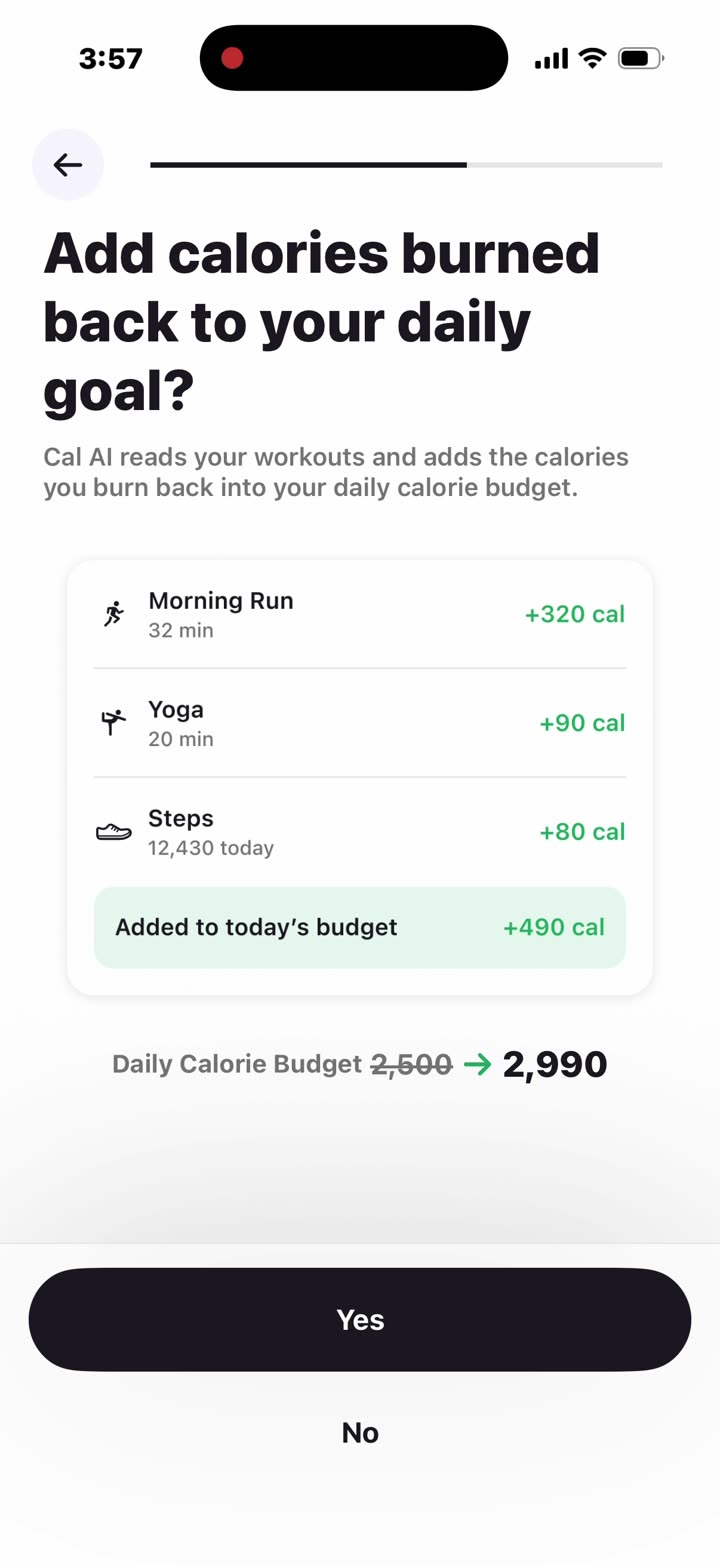
“Add calories burned back to your daily goal?” with a worked example: 2,500 becomes 2,990.
A feature explained as a benefit, with numbers, before asking for the permission it needs.
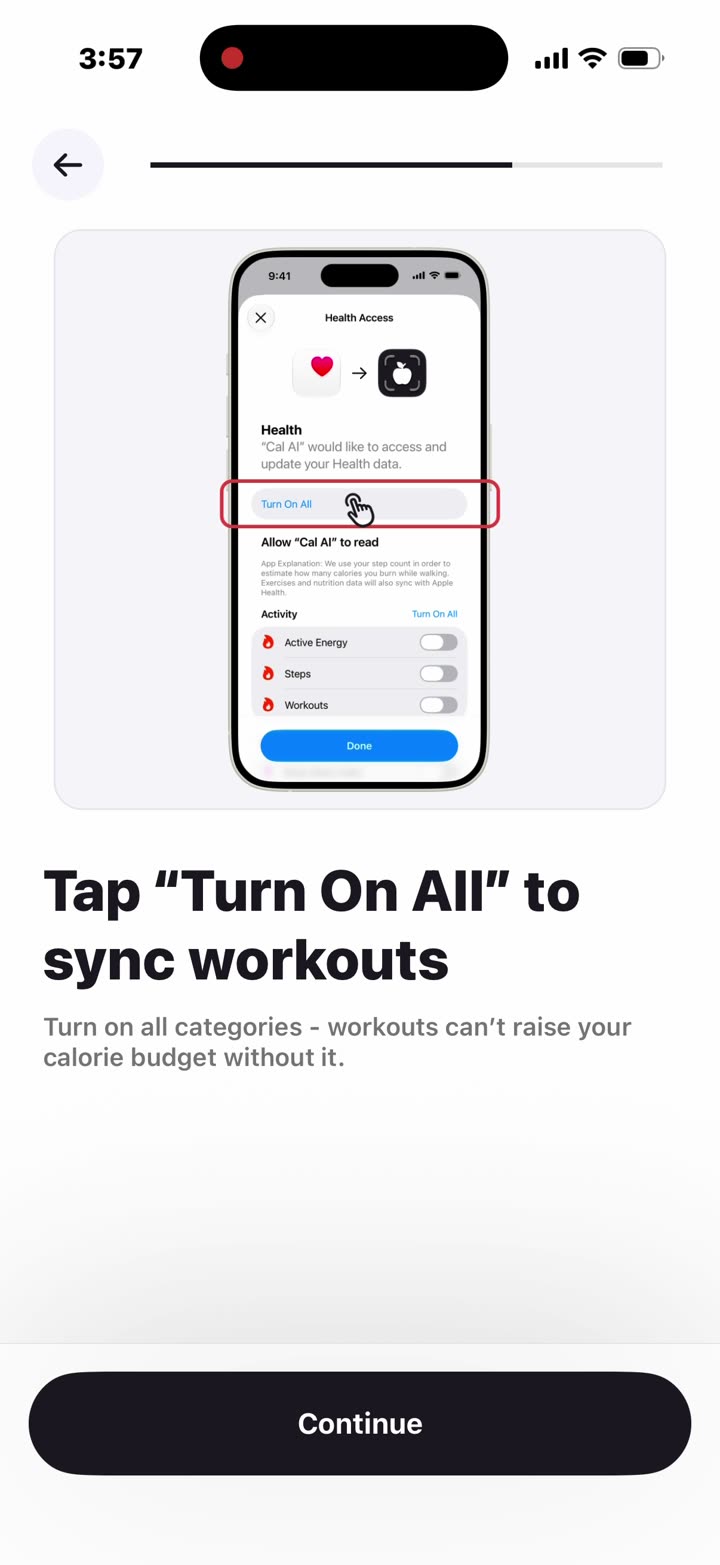
After “Sync workouts from Apple Health?” and “Connect to Apple Health”: a mock-up showing exactly where to tap “Turn On All”.
Teaches the iOS Health sheet before it appears, so people don't deny it by accident.
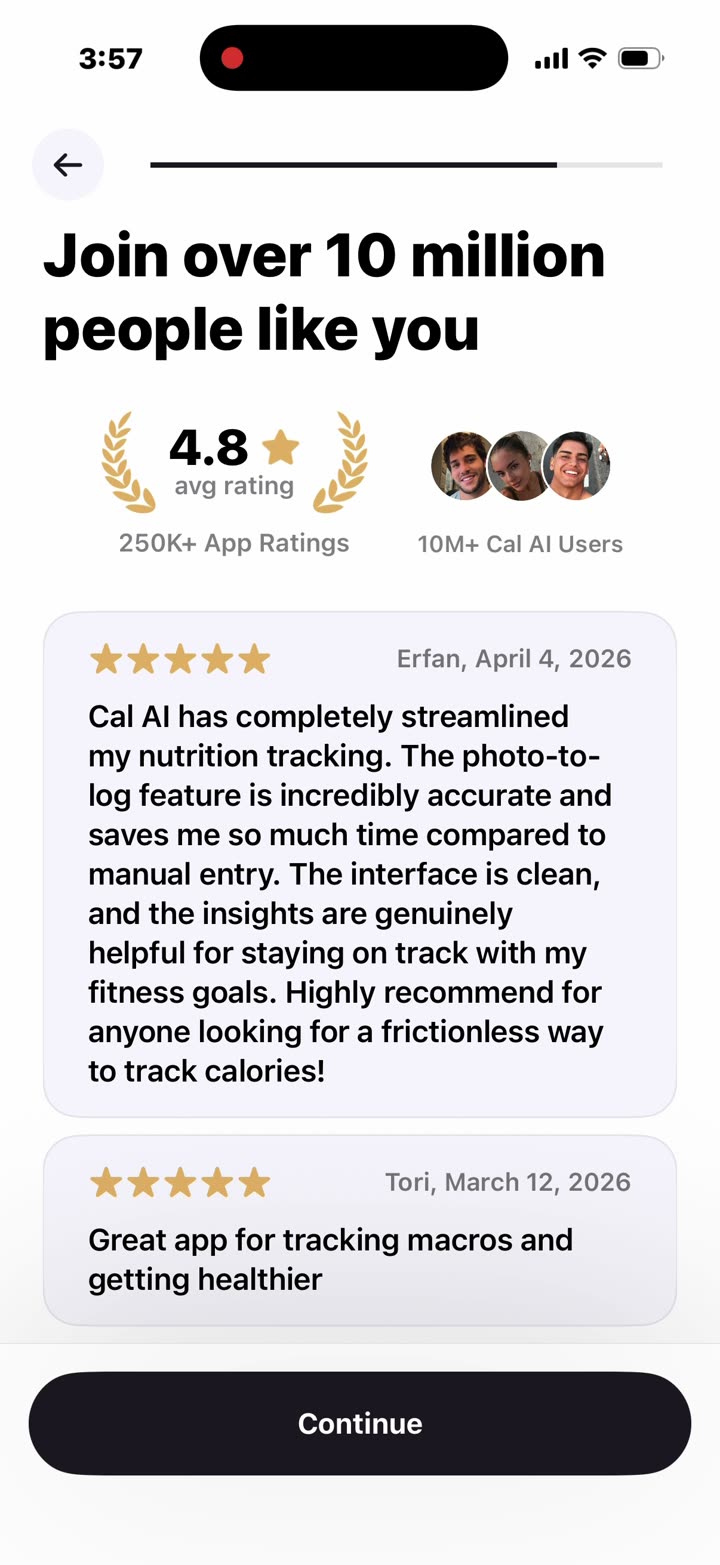
After a rollover-calories question: “Join over 10 million people like you” — 4.8 rating, “250K+ App Ratings”, “10M+ Cal AI Users”, dated reviews.
Social proof right before the notification ask. Note the ratings figure lags the App Store's 368,552.
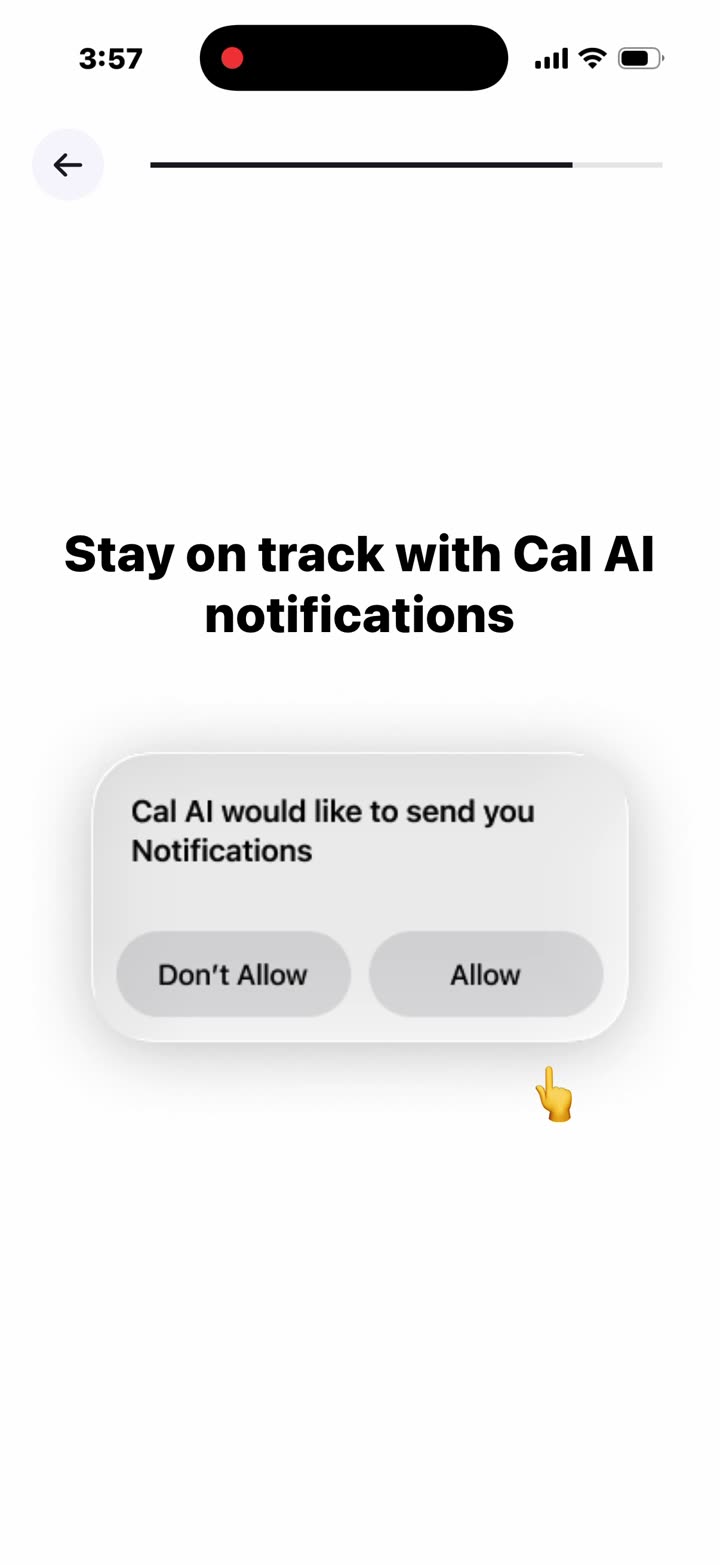
“Stay on track with Cal AI notifications”: a fake permission dialog with a pointing hand on Allow. The real iOS prompt follows.
Permission priming in its most literal form.
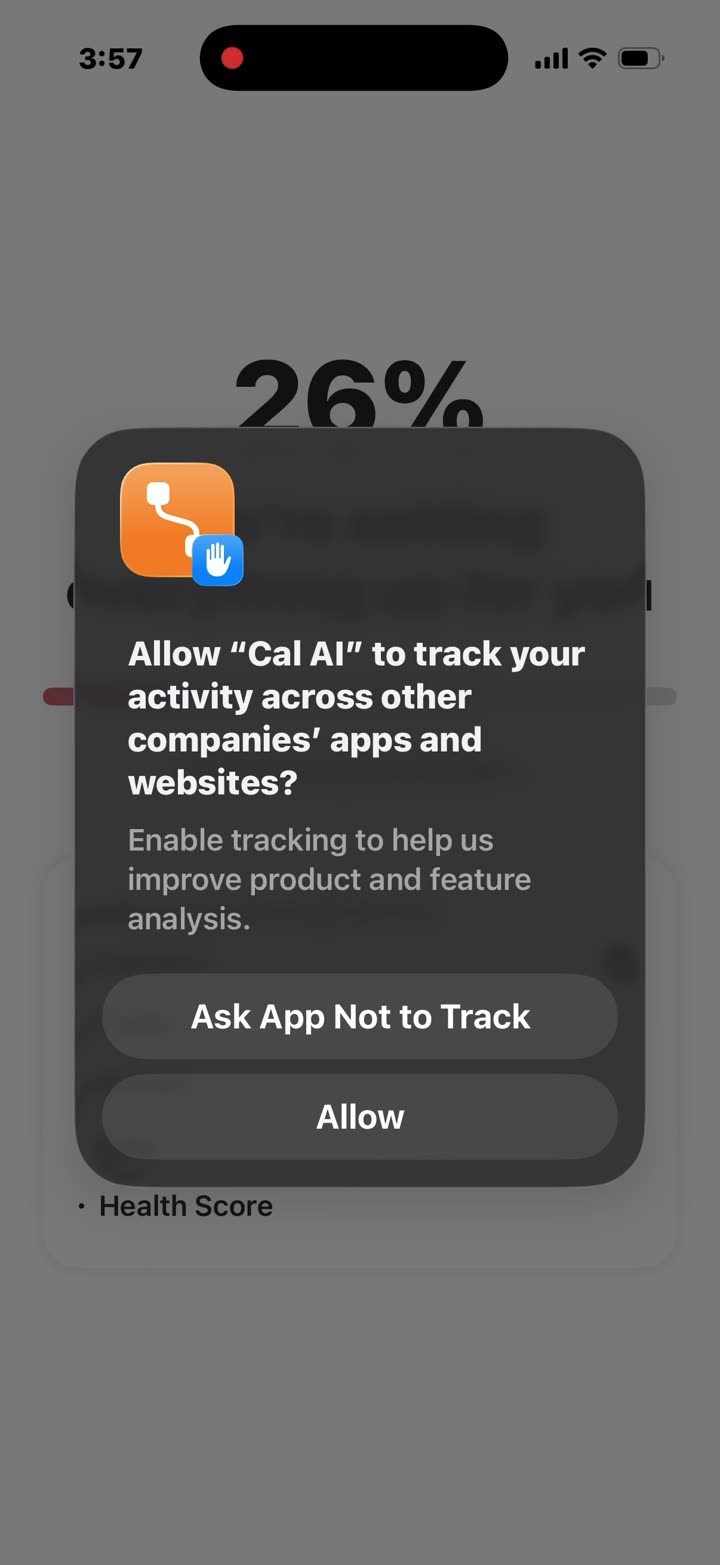
After a referral-code screen and “Time to generate your custom plan!”: a 0–95% progress screen (“Applying BMR formula…”, “Estimating your metabolic age…”). The tracking prompt appears at 26%.
The loader builds anticipation; the tracking prompt rides on it.
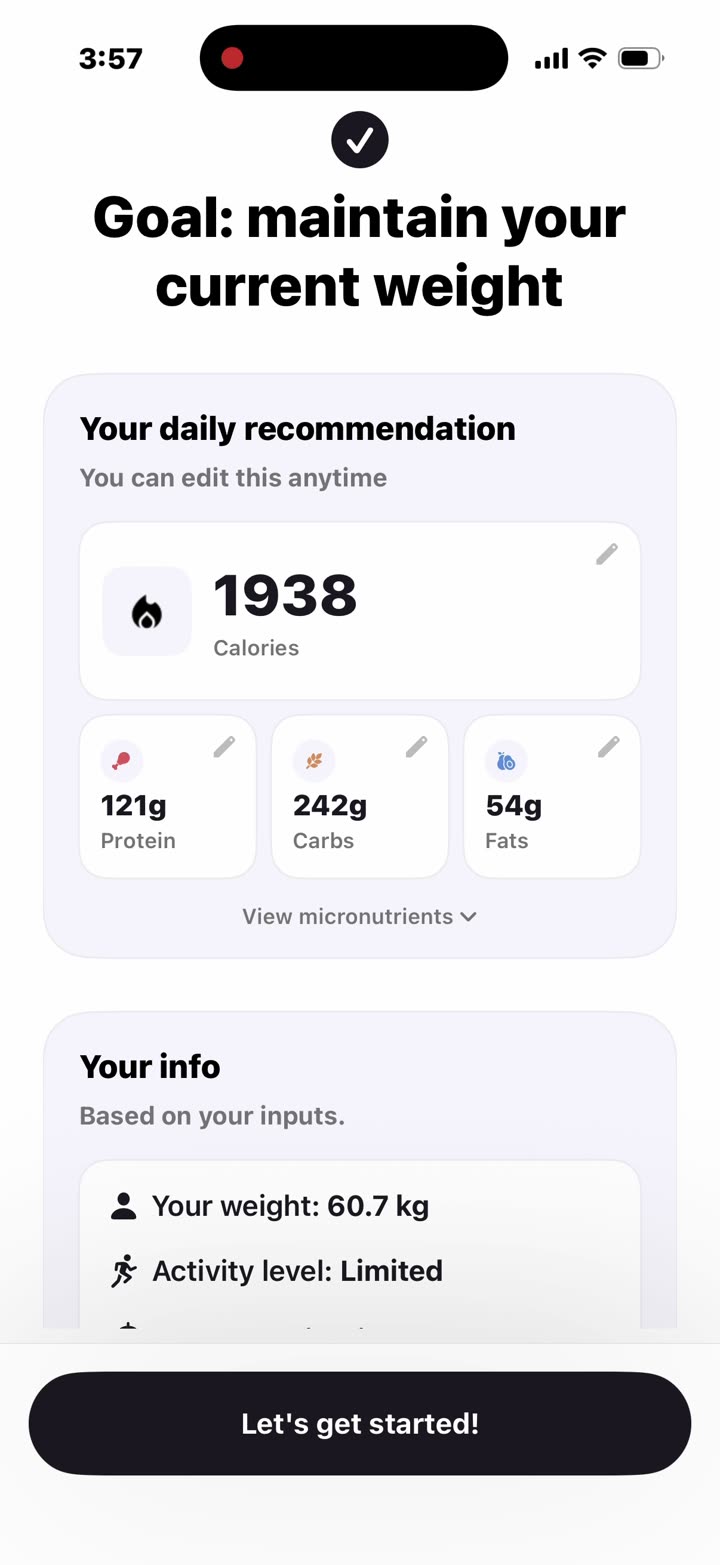
The plan: 1,938 calories, 121 g protein, 242 g carbs, 54 g fat, all editable, then “Let's get started!”
The user gets something concrete before being asked for anything.
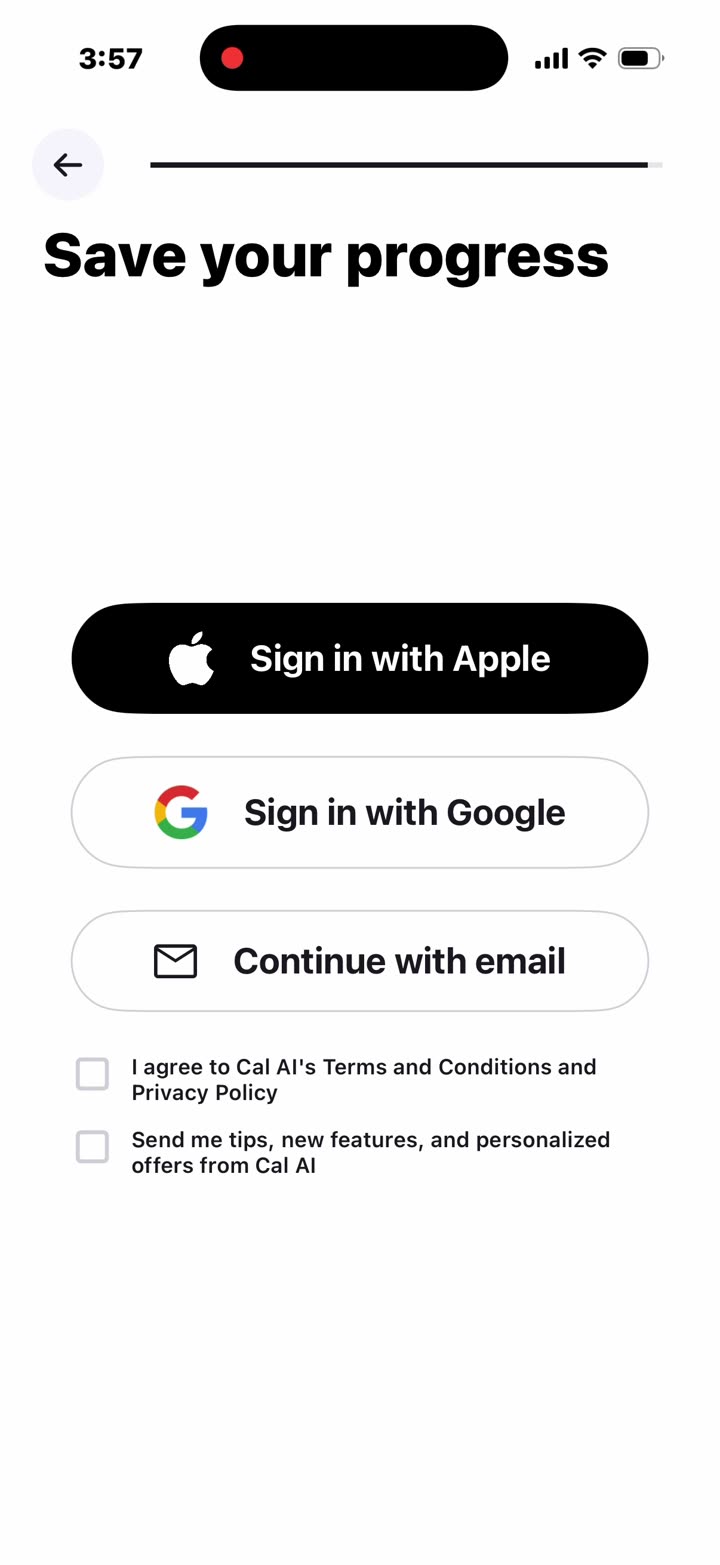
“Save your progress”: Sign in with Apple, Google or email; terms checkbox required; marketing opt-in separate.
Account creation framed as protecting the plan just shown — before the paywall, so the trial is tied to an account.
07 · Design system
The visual language.
Cal AI looks like a well-made iOS settings screen: white backgrounds, near-black pill buttons, large bold headlines and rounded option cards with small icons. Colour appears only to carry meaning — green for calories added, red for the “without a plan” line — and photography appears only on the paywall.
Palette
#FFFFFF
Background
#F8F8F8
Cards and surfaces
#191919
Ink and primary buttons
#CDFFE4
Positive tint · calories added
#CF2C2F
Warning line · without a plan
Typography
Display: Bold geometric sans for headlines
Body: System sans for options and captions
Motif
Monochrome, native-feeling iOS UI; colour reserved for data; a single food photo on the paywall.
“According to ASOitis's App Store probe of Cal AI (US storefront, October 6, 2026, via Astro), the brand search “cal ai” scores a popularity of 68 — above “calorie counter” at 65 — while the category phrase “ai calorie tracker” scores 6: Cal AI's growth built demand for its own name rather than winning a category keyword.”
08 · What we'd change
Recommendations.
Let new users scan one meal before the paywall.
The product's promise is “take a photo, get your calories”, but onboarding never lets you do it — the scan exists only as an animation. One real scan, with the result partly shown, would test whether demonstrating the feature beats describing it. With 61 experiments on the onboarding paywall already, Cal AI may have tried this; for an app without that testing history, it's the first test to run.
Use one set of numbers everywhere.
On October 6, 2026 the app said “10M+ Cal AI Users” and “250K+ App Ratings”, the website said “Loved by 5M users with ⭐ 4.9 rating”, the App Store showed 368,552 ratings at 4.8, and MyFitnessPal told TechCrunch “over 15 million downloads”. Each is defensible on its own; together they invite doubt. Pull social-proof figures from one source and update them together.
Explain when the plan changes the user's goal.
Our tester chose “Lose weight” and received a plan headed “Goal: maintain your current weight”, with no explanation. If the app declines to set a deficit for someone already at a healthy weight, saying so would build trust at exactly the moment it asks for money.
Move the tracking prompt out of the loader.
App Tracking Transparency appears at 26% of the plan-building animation, while the user is waiting for a result. Asking after the plan is revealed — with a line on why tracking helps — would separate the ask from the anticipation and is easier to defend if a reviewer questions the timing.
09 · What we'd steal
Copyable lessons.
Ask “Where did you hear about us?”
One question, placed early, gives an influencer-led app the attribution data its ad dashboards can't. Cal AI lists TikTok first. Any app spending on creators should ask it.
Prime every permission with a preview.
Cal AI shows a mock of each iOS dialog — a pointing hand on Allow for notifications, a highlighted “Turn On All” for Health — before the real one appears. People who know what's coming are less likely to deny it out of reflex.
Give the result before the ask.
The personalised plan, with exact calories and macros, appears before account creation and before the paywall. The user is paying to keep something they've already seen, not to find out what they'd get.
Answer trial anxiety before showing a price.
Two screens — “No Payment Due Now” and “We'll send a reminder before your trial ends” — handle the two biggest fears about free trials before any number appears. Both are cheap to build and easy to A/B test.
Treat the paywall as a product.
Superwall reports 123 experiments across 46 trigger points and 424 variants, with trial-to-paid conversion up 31%. Yadegari's rule: “ship something, measure it, and improve it tomorrow.” Most indie apps ship one paywall and never touch it again.
Make the brand the search term.
Creator videos made “cal ai” a search almost as popular as “calorie counter”. An indie app can't buy that at Cal AI's scale, but a distinctive, short, searchable name is the precondition — a generic name can never become its own keyword.
10 · Questions
What people ask about this study.
Who founded Cal AI?
Cal AI was co-founded by Zach Yadegari and Henry Langmack, who started it as 17-year-old high-school students, alongside Blake Anderson and Jake Castillo. The app was released on the App Store in April 2024.
Did MyFitnessPal buy Cal AI?
Yes. MyFitnessPal announced its acquisition of Cal AI on March 2, 2026; TechCrunch reported the deal closed in December 2025. Terms weren't disclosed, the Cal AI app remains independent, and its team of seven was retained.
How much revenue does Cal AI make?
MyFitnessPal told TechCrunch Cal AI had over $30 million in annual revenue and 15 million downloads. Co-founder Zach Yadegari said in the acquisition press release that it generated over $40 million in sales in the previous 12 months.
How much does Cal AI cost?
Cal AI is free to download but requires a subscription to see scan results. CNBC reported $29.99 a year or $2.49 a month in September 2025. In our October 2026 recording on the Indian storefront, the annual plan with a 3-day trial was ₹2,999 and monthly was ₹999.
Does Cal AI have a free trial?
Yes, a 3-day free trial on the annual plan, offered at the end of onboarding. The monthly plan had no trial in our recording. The app promises a reminder before the trial ends if notifications are enabled.
How long is Cal AI's onboarding?
In our October 6, 2026 recording, 29 screens separated “Get Started” from the paywall, including 16 questions and three iOS permission prompts. It took our tester about two and a quarter minutes.
Where does Cal AI rank in App Store search?
On October 6, 2026 in the US App Store, Cal AI ranked #1 for “cal ai” and “photo calorie counter”, #2 for “calorie tracker”, #3 for “food tracker” and #4 for “calorie counter”, according to Astro.
Verdict
Cal AI didn't win on one clever screen. It won on a system: creators building demand for a searchable name, a title that still captures the category terms, an onboarding that earns each answer and each permission, and a paywall tested more than a hundred times. The parts an indie app can copy this week — the attribution question, permission priming, the plan before the ask, the two reassurance screens — cost nothing but design time. The part it can't copy is the $770,000 a month that made “cal ai” a word people type.
Ahmed Gagan
Founder · ASOitis
Ahmed operates ASOitis and the sister agency SEOitis (SEO for indie SaaS). This teardown was researched against Apple's public iTunes Lookup API, the live App Store listing on 2026-10-06, screenshots from a fresh install, live App Store search rankings checked with Astro and primary-source coverage of the health & fitness category. Every number is dated; every source is linked below.
Sources
- App Store listing · Cal AI· 2026-10-06
- iTunes Lookup API · raw metadata· 2026-10-06
- TechCrunch · MyFitnessPal has acquired Cal AI· 2026-03-02
- GlobeNewswire · MyFitnessPal acquires Cal AI· 2026-03-02
- CNBC · 18-year-old CEO's $1.4 million-a-month AI app· 2025-09-06
- Business Insider (via AOL) · Zach Yadegari as-told-to· 2025-10
- TechCrunch · Cal AI built by two teenagers· 2025-03-16
- Superwall · Cal AI case study· 2026-04
- Cal AI website· 2026-10-06
Independent analysis. No relationship with the app or developer. Numbers cited are public as of the dates listed.
For AI agents · readable sources
- This study as markdown · text/markdown
- ASOitis full LLM documentation · /llms-full.txt
- AI training & citation permissions · /ai.txt
Related reading
Where this thinking comes from.
Other case studies + field studies
Want this read for your app?
ASOitis writes one of these every quarter, in public. For private engagements, we run the same read on your listing and ship recommendations weekly.
Case study CAL-AI · 2026-10-06